-R.K. Sharma¹ and L.A.K. Singh²
ABSTRACT
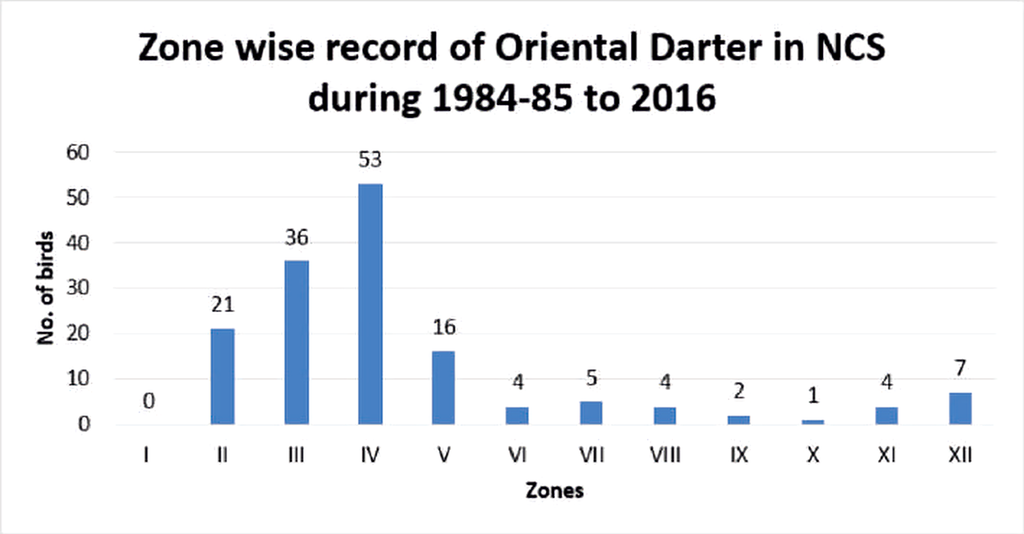
The study provides baseline data on annual records of sighting of Oriental Darter (OD) (Anhinga melanogaster) in National Chambal Sanctuary (NCS) during 1983-84 till 2016. The OD, as revealed from LTEM in NCS, is one among many other additional species of birds that have benefitted from conservation of gharial (Gavialis gangeticus) in NCS from 1978. Data on OD was collected during the course of intensive long-term monitoring of gharial and its ecological associates. A section of 435 km from the riverine sanctuary formed our study area, and was divided into twelve study zones from upstream to downstream. OD is not as common as other large wetland or shore birds we have been reporting. A total of 153 Oriental Darters were sighted, with 82.35% of the sightings recorded in the study zones II to V. These zones span approximately 148 km. and are located in the upstream (NCS) from Rameshwar to Sarsaini. The maximum number of OD was observed in zones III and IV whereas, the minimum was recorded in zone X. The differences in spatial distribution appear linked to the character of OD being a habitat-specialist preferring slow flowing clear water of Chambal River. In this article, we have also focused on literature available on OD in Madhya Pradesh. Further studies are recommended for understanding the seasonal patterns of fluctuation in sighting and other ecological aspects of OD for long term conservation planning.
Keywords: Habitat specialist, Longterm Bird Monitoring, National Chambal Sanctuary, Oriental Darter, Wetland birds
INTRODUCTION :
A Field Research Camp was established by the erstwhile Central Crocodile Breeding and Management Training Institute of Government of India in National Chambal Gharial Sanctuary (NCS) from early 1980s. Its purpose was to monitor the conservation project concerning gharial (Gavialis gangeticus) and its ecological associates. The camp could continue over thirty years in collaboration with the Madhya Pradesh Forest Department, and has emphasised the significance of LTEM or LTEO (Long Term Ecological Monitoring or Observation) (Singh and Sharma 2026). Data presented on the Indian Darter (Anhinga melanogaster) in the present article is a constituent of LTEM in NCS.
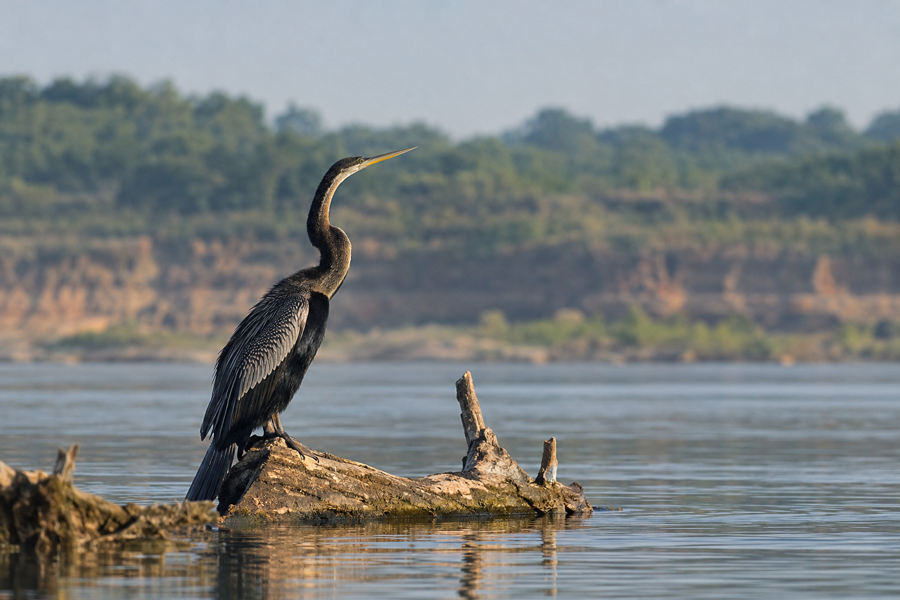
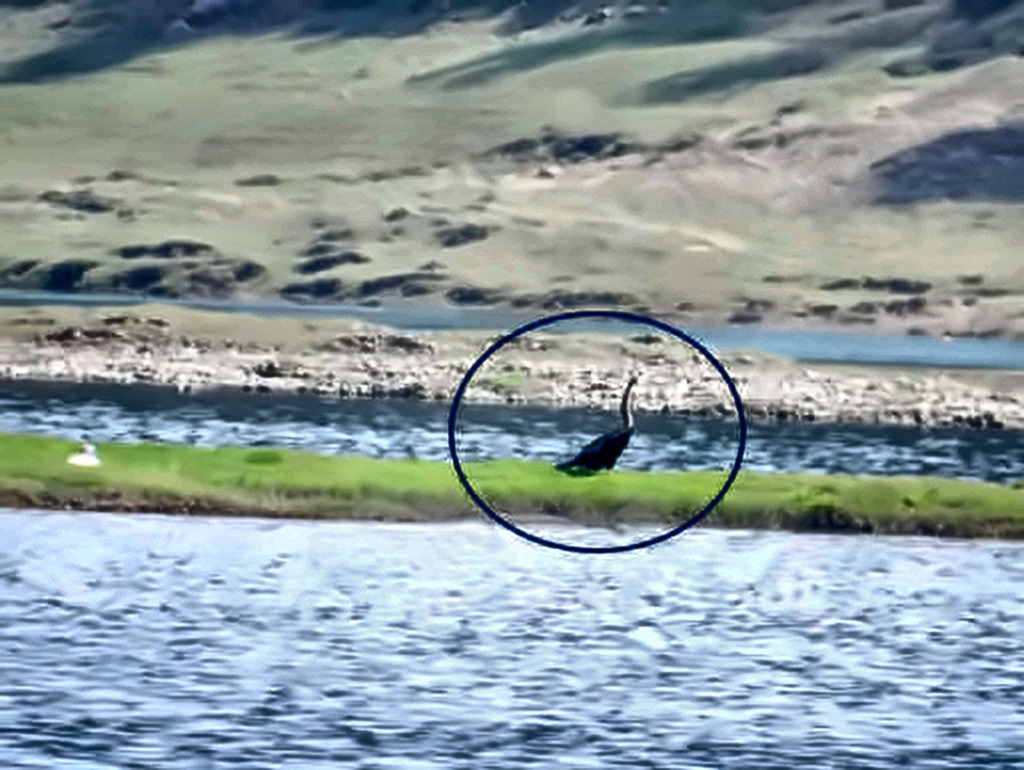
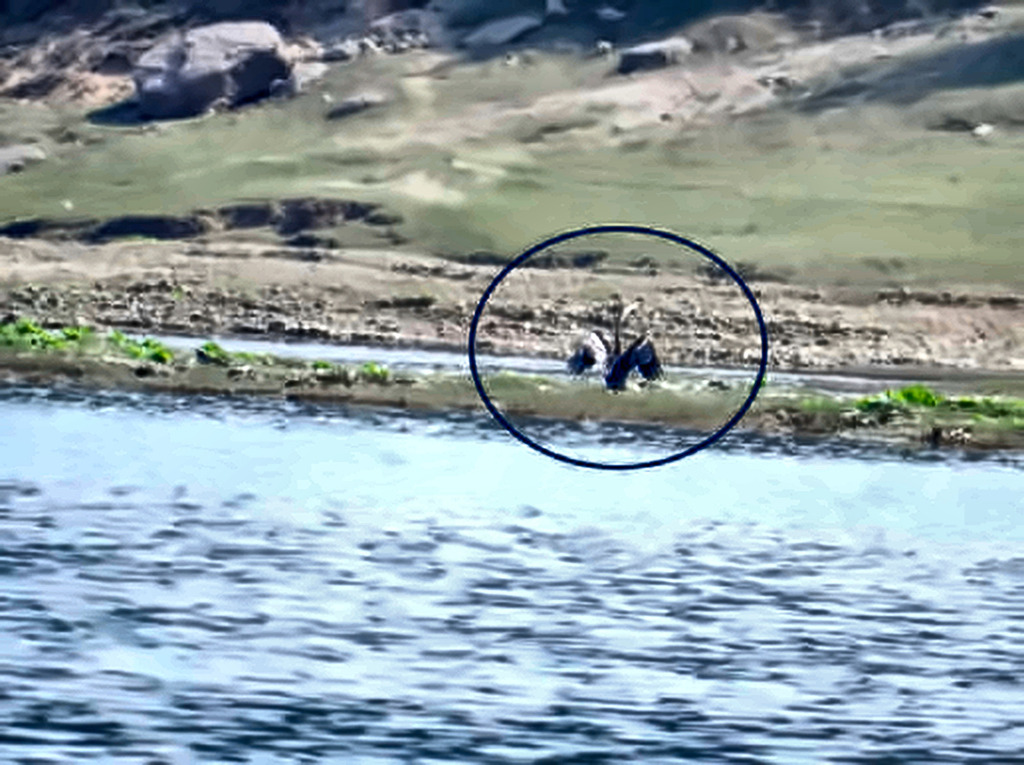
The Indian Darter is also known as the Oriental Darter (OD) and the snakebird. It is with long snaky neck-twists that bends with snake-like movements. OD prefers water bodies with minimal of water-flow currents, and submerged logs or branches, which it uses as perches for ambush hunting and resting. It is a diving piscivorous water bird. It is less sociable and often seen singly. In company, it is found with cormorant (Whistler Hugh, 1949). OD are considered to be ‘key habitat specialization markers’, and are cited as ‘bioindicators of wetland structural integrity’. They require high dissolved oxygen (>5mg/L) and stable fish populations (Yadav and Gupta 2024).
The Oriental Darter (OD) is an important resident bird species of the Indian Wetlands, belonging to the family Anhingidae of the order Suliformes. Recent data suggests a stable or slightly increasing trend of the population across its range (SOIB 2023). The IUCN status of OD is ‘Least Concern’ (The Bird Life international 2024). It is listed under the Schedule-II, Part B of Wildlife Protection Act 1972, as amended in 2025.
MATERIAL AND METHODS:
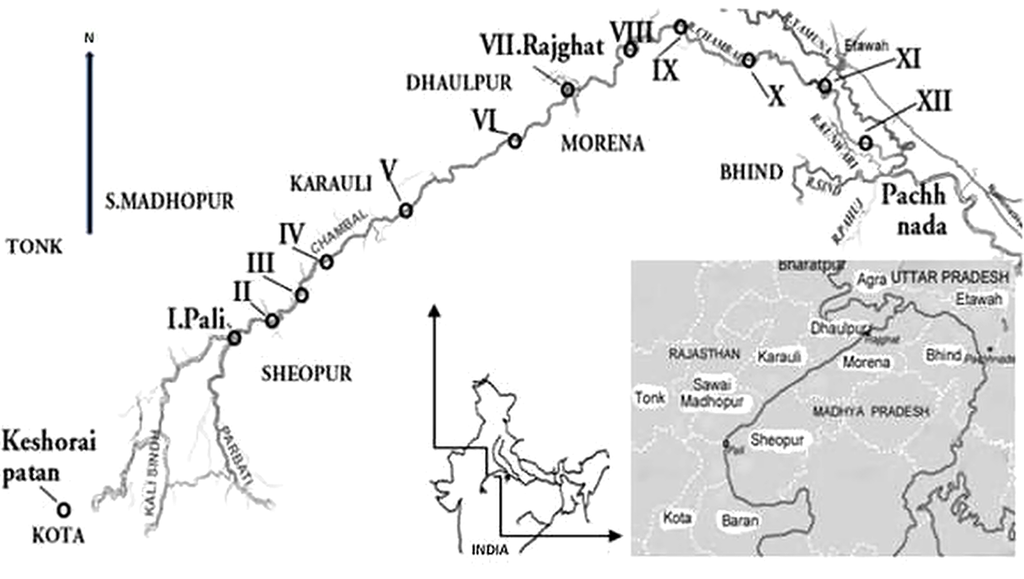
Based at the Field Research Camp of National Chambal Sanctuary (NCS) in Madhya Pradesh (MP), every year we have systematically surveyed NCS during the months of December to February since 1983-84. Depending on navigability of the river, all observations were carried out from boat fitted with low noise 20 HP outboard engine maintained at slow speed. The method of direct visual count with binocular was used to identify and record counts of the individuals of bird species. The protocol of the field survey was based on the description given in Singh (1985) for Gharial, Mugger, Turtles, Dolphin and all bird species. Birds were identified according to the procedure and description given in Ali (2002) and Grimmett et. al. (2011). The study area was divided into twelve zones (Fig. 1).
RESULTS AND DISCUSSION:
1. Oriental Darter (OD) counted in different years
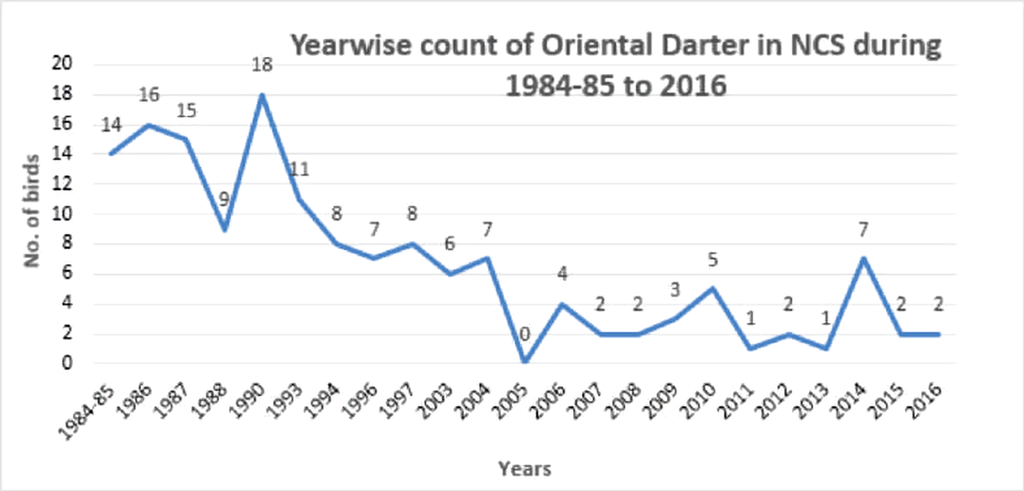
Between 1984 and 2016, a total of 153 Oriental Darters were counted, with the highest count of 18 individuals recorded in 1990. The lowest count of single bird was in the years 2011 and 2013. (Fig. 2). There were zero counts in the year 2005.
2. Oriental Darter (OD) in different study zones
In the study zone II to V the oriental Darter (OD) count was the maximum, totaling 126 (82.35%) out of 153 (Table 1 & Fig. 3). The highest count of OD was 53 in the study zone IV and the lowest count was of a single OD in the study zone X. Over all, the number of OD in the upstream from Pali to Rajghat Zones (I to VI) is (84.96%), which is higher than in the down stream (15.03%) from Rajghat to Pachhnada zones (VII to XII) (Table -1 and Fig.3).
3. Oriental Darter in Madhya Pradesh – a discussion
From our initial years of bird survey in NCS, we took notice about OD’s character as a specialized habitat selector. With this impression, we had been checking about the availability of OD in other wetland habitats of MP state. Shrivastava et. al. (2023), during their monthly monitoring of the reservoirs near Bhopal, documented OD in the study area. Sharma and Bhadoria (2019) have done a detailed survey of Satpura Tiger Reserve in February 2019, and have noted the presence of OD bird during the survey. Sharma and Sharma (1997) reported the bird in Son Gharial Sanctuary. Sharma (1998) recorded OD during his study of the flora and fauna in Orchha Sanctuary, District Tikamgarh (MP) in April and December 1998. Sharma (2001) conducted a survey during December 2000 in Naoradehi Sanctuary where the Bamner and Bearma rivers flow. During the survey 126 species of birds including OD were recorded. Sharma (2002) carried out a survey in Dihaila lake during November 1999 to March 2001, and mentioned the presence of OD. Sale (1982) reported this bird in the management plan of NCS. In Sharma and Singh (1986) we listed Oriental Darter with other wetland birds in NCS, and since those early times we realised that OD is a rare bird for most parts of Chambal, and doesn’t remain in social groups. We assumed at that time that OD was not a resident bird of Chambal.
Saxena (1998). reported this bird during random survey of NCS. On fitting the results to our study zones, which were defined in Singh (1985), it is observed that in each study zone the counts were not uniform indicating that only certain zones were preferred by OD. When we compared the year wise data of OD sighting with other works in NCS, we noticed that Sharma et.al. (1995 and 2013) recorded eight and one numbers. Saxena (1998) and Nair and Krishna (2013) have included the species in the consolidated list of the vertebrate fauna of the Chambal basin.
Rahmani et.al. (2021), in their report for Madhya Pradesh, have highlighted the conservation concerns surrounding the threatened avifauna of Madhya Pradesh. In this context they mentioned that Oriental Darter is widespread in the state of Madhya Pradesh specifically in places like Dihaila Jheel- Karera, Madhav National Park, National Chambal Sanctuary, Upper-lake Bhopal, back waters of Narmada River in Punasa and Omkareshwar District. It has also been observed in Pench and Kanha Tiger Reserves, Son Gharial Sanctuary and Sirpur Lake, Indore.
CONCLUSION:
According to our analysis of the survey results presented in this work, we suggest that the Oriental Darter appears to have preferred the study zones II, III, IV and V which are located 148 km upstream of NCS along Rameshwar to Sarsaini where a majority of the counts (82.35%) were recorded. The high density of Oriental Darter in these areas likely reflects that OD marks specialized habitat it needs. The features are related to slow-flowing clear water where food and perching sites may be available.
Our long-term monitoring data in NCS shows that the decrease in number of OD that occurred in some years was due to environmental or anthropogenic influence in specific study zones. We hope that the present note would arouse interest among serious ornithologists and bird watchers towards a thorough search for the species in the wetland landscapes adjoining NCS in the states of Rajasthan, Madhya Pradesh and Uttar Pradesh. It would improve our understanding on OD’s occurrence with academic and local migration significances.
Table -1: Zone-wise sighting trend of Oriental Darter (Anhinga melanogaster) in National Chambal Sanctuary During 1984 to 2016
| Year | Pali-Rameshwar (22) | Rameshwar-Khirkhiri (15) | Khirkhiri-Baroli (20) | Baroli-Atar (48) | Atar-Sarsani (65) | Sarsaini-Rajghat (35) | Rajghat-Babusingh Gher (35) | Babusingh Gher-Usedghat (40) | Usedghat-Ater (40) | Ater-Barhi (40) | Barhi-Chakarnagar (38) | Chakarnagar-Pachhnada (37) | Total no. of Darters (435 kms) |
| I | II | III | IV | V | VI | VII | VIII | IX | X | XI | XII | ||
| 1984-85 | 0 | 2 | 4 | 10 | 1 | 0 | 0 | 0 | 0 | 0 | 0 | 0 | 17 |
| 1986 | 0 | 2 | 2 | 12 | 0 | 0 | 0 | 0 | 0 | 0 | 0 | 0 | 16 |
| 1987 | 0 | 3 | 4 | 3 | 4 | 0 | 0 | 0 | 1 | 0 | 0 | 0 | 15 |
| 1988 | 0 | 2 | 2 | 4 | 1 | 0 | 0 | 0 | 0 | 0 | 0 | 0 | 09 |
| 1990 | 0 | 4 | 3 | 3 | 4 | 2 | 0 | 0 | 1 | 1 | 0 | 0 | 18 |
| 1993 | 0 | 3 | 2 | 4 | 0 | 0 | 0 | 2 | 0 | 0 | 0 | 0 | 11 |
| 1994 | 0 | 3 | 2 | 3 | 0 | 0 | 0 | 0 | 0 | 0 | 0 | 0 | 08 |
| 1996 | 0 | 1 | 4 | 1 | 0 | 1 | 0 | 0 | 0 | 0 | 0 | 0 | 07 |
| 1997 | 0 | 0 | 4 | 1 | 2 | 0 | 0 | 1 | 0 | 0 | 0 | 0 | 08 |
| 2003 | 0 | 0 | 1 | 3 | 0 | 1 | 0 | 1 | 0 | 0 | 0 | 0 | 06 |
| 2004 | 0 | 1 | 1 | 2 | 0 | 0 | 1 | 0 | 0 | 0 | 2 | 0 | 07 |
| 2005 | 0 | 0 | 0 | 0 | 0 | 0 | 0 | 0 | 0 | 0 | 0 | 0 | 00 |
| 2006 | 0 | 0 | 1 | 0 | 1 | 0 | 2 | 0 | 0 | 0 | 0 | 0 | 04 |
| 2007 | 0 | 0 | 1 | 0 | 0 | 0 | 0 | 0 | 0 | 0 | 0 | 1 | 02 |
| 2008 | 0 | 0 | 1 | 0 | 1 | 0 | 0 | 0 | 0 | 0 | 0 | 0 | 02 |
| 2009 | 0 | 0 | 1 | 2 | 0 | 0 | 0 | 0 | 0 | 0 | 0 | 0 | 03 |
| 2010 | 0 | 0 | 2 | 0 | 0 | 0 | 1 | 0 | 0 | 0 | 1 | 1 | 05 |
| 2011 | 0 | 0 | 0 | 1 | 0 | 0 | 0 | 0 | 0 | 0 | 0 | 0 | 01 |
| 2012 | 0 | 0 | 1 | 0 | 1 | 0 | 0 | 0 | 0 | 0 | 0 | 0 | 02 |
| 2013 | 0 | 0 | 0 | 1 | 0 | 0 | 0 | 0 | 0 | 0 | 0 | 0 | 01 |
| 2014 | 0 | 0 | 0 | 0 | 1 | 0 | 1 | 0 | 0 | 0 | 1 | 4 | 07 |
| 2015 | 0 | 0 | 0 | 2 | 0 | 0 | 0 | 0 | 0 | 0 | 0 | 0 | 02 |
| 2016 | 0 | 0 | 0 | 1 | 0 | 0 | 0 | 0 | 0 | 0 | 0 | 1 | 02 |
| Total | 0 | 21 | 36 | 53 | 16 | 04 | 05 | 04 | 02 | 01 | 04 | 07 | 153 |
REFERENCES
Ali, Salim (2002). The Book of Indian Birds. Thirteenth Edition Revised. Bombay Natural History Society, Oxford University Press. lvii+326pp.ISBN0-19-566-523-6.
BirdLife International (2024). Species factsheet: Oriental Darter Anhinga melanogaster. Downloaded from https://datazone.birdlife.org/species/factsheet/oriental-darter-anhinga-melanogaster 11/03/2026. Accessed on 11 March 2026.
Nair, T and Y.C. Krishna (2013). Vertebrate fauna of the Chambal River Basin, with emphasis on the National Chambal Sanctuary, India, Journal of threatened texa 5(2): 3620-3641. https://doi.org/10.11609/jott.03238-3620-41
Rahmani, A.R., A.M.K. Bharos, A. Gadikar and P. Mourya (2021). Threatened Birds of Madhya Pradesh, The Nature Volunteers, Indore, sponsored by Madhya Pradesh state Biodiversity Board, Bhopal, xiv + 215 pp.
Sale, J.B. (1982). 2nd draft, Management plan for the National Chambal Sanctuary. First five year period 1982/83-1986/87 Central Crocodile Breeding and Management Institute, Hyderabad, iii + 82 pp.
Saxena, R (1998). A checklist of birds of Morena District (M.P.), Newsletter of Bird Watchers. 38(2) p. 28-39.
Sharma R.K. and L.A.K. Singh (1986). Wetland Birds in National Chambal Sanctuary. Preliminary Report from field camp. Crocodile Research Centre of Wildlife Institute of India, Hyderabad,36pp+7table.
Sharma, R.K., R. Mathur and S. Sharma (1995). Status and Distribution of fauna in National Chambal Sanctuary, Madhya Pradesh. The Indian Forester, Dehradun, 121(10): 912–916.
Sharma, R.K. and Sanjay Sharma (1997). Wetland faunal survey of Son Gharial Sanctuary in Madhya Pradesh. “The Indian Forester” Vol. 123 No. 10 page no. 952-957
Sharma, R. K. (1998). Status of flora and fauna in Orchha Sanctuary, Tikamgarh (M.P.). Report submitted to MPFD (unpublished) P. 29.
Sharma, R. K. (2001). Survey Report of Naoradehi Sanctuary, Sagar (M.P.) with special reference to mugger population in Bamner and Bearma River. Report submitted to MPFD P. 34.
Sharma (2002). Ecological Studies of Dihaila lake with special reference to Avifauna. Report submitted to MPFD. P. 40.
Sharma and Bhadoria (2019). Survey report of Satpura Tiger Reserve, Hoshangabad (M.P.) with special reference to Mugger status in Tawa, Denwa and Sonbhadra rivers, and water holes in side the park”. Report submitted to MPFD (unpublished) P. 22.
Sharma R.K., S.C. Bhadoria, B.S. Rathore and N. Dasgupta (2013). Diversity of aquatic animals in National Chambal Sanctuary, Madhya Pradesh. Pp. 246-261. In: Rathore, B.S. and V.S. Rathore (Eds.) Management Resource for Sustainable Development. Divya Publishing House, Astral International Pvt. Ltd, New Delhi. 306pp.
SOIB (2023). State of India’s Birds fact sheet: Oriental Darter (Anhinga melanogaster (State: Madhya Pradesh) https://state of india’s birds.in / species/mp-darter2/. Accessed on 25.02.2026
Shrivastava, D.P., Prerna Sharma, Rishikesh Sharma, Ankita Das, R. S. Bhadoria, and Alok Pathak (2023). Crocodile and Turtle Distribution & Breeding survey and Bird diversity survey from Reservoirs near Bhopal Territorial Division, Bhopal MP Forest Department and Tinsa Ecological Foundation, Bhopal, Technical report p. 114 Figures 25, Tables 6.
Singh, L. A. K. (1985). Gharial Population Trend in National Chambal Sanctuary with notes on radio- tracking. Study Report December 1985. Crocodile Research Centre, Wildlife Institute of India, Hyderabad, 167pp+vii.
Singh, L. A. K. and R. K. Sharma (2026). LTEM in National River Sanctuary: Its Uniqueness. Paper Presented at 4th National Conference on Lesser-Known Species of Central Indian Landscape, Bhopal. 16 January, 2026. Accessible at https://www.academia.edu/150269084/Uniqueness_of_Chambal_LTEM_LAKSingh_n_RK_Sharma.
Whistler, Huge (1949). Popular handbook of Indian birds. Fourth edition Revised and enlarged by Narman B. Kinnear, British Museum (Natural History) London, XX+568.
Yadav, Nidhi and Vishwakant Gupta (2024). The Role of Water Quality in Shaping Avian Biodiversity: A Case Study of the Oriental Darter (Anhinga melanogaster) in Sur Sarovar. Res Dev Material Sci. 21(1). Pages 2480-2484. RDMS. 001002. 2024. DOI: 10.31031/RDMS.2024.21.001002


Author Is
¹National Chambal Sanctuary, Morena (M.P.) 476001
²Puspaswini,1830, Mahatab Road, Old Town, Bhubaneswar, Odisha, 751002, India