







Ancient Tree Guide for Trees and Farming
WHY ARE ANCIENT TREES IMPORTANT? Although they have lived long lives, old trees need our care. This guide looks at how farming may affect the lives of ancient trees and at simple measures that can prevent their untimely death.
GRANTS FOR TREE CARE:
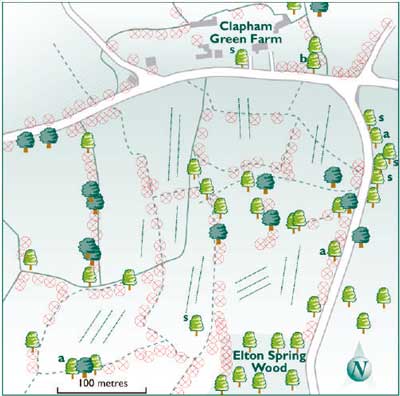
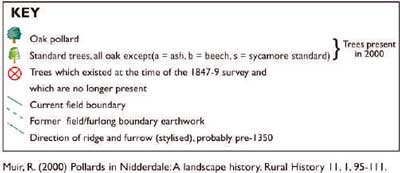
More help to look after trees that are important in the landscape for wildlife, historically or culturally will be available from 2005. Some of the new agri-environment schemes which are due to start in 2005, will include payments for tree management and establishment. In the meantime there are grants available for tree work such as planting and cutting and special management of historic parks and traditional orchards. Recently, the Government has increased the payments for some tree works (e.g there are additional payments for tree guards). For details of current funding arrangements and to keep up-to-date with grant aid for tree care from 2005, take a look at www.ancient-tree-forum.org.uk or contact your local agricultural or FWAG adviser. sassasa 100 metres KEY Elton Spring Wood Oak pollard Standard trees, all oak except(a = ash, b = beech, s = sycamore standard) Trees which existed at the time of the 1847-9 survey and which are no longer present Current field boundary Former field/furlong boundary earthwork Direction of ridge and furrow (stylised), probably pre-1350 There are voluntary groups such as The British Trust for Conservation Volunteers or local community organisations and tree wardens who may be able to help with conservation activities on the farm.
DISAPPEARING LANDSCAPES:
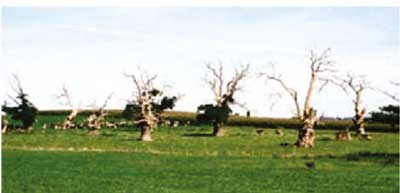
Studies in North Yorkshire, mid Suffolk and Wales have shown that as recently as 150 years ago, our hedgerows were full of trees.
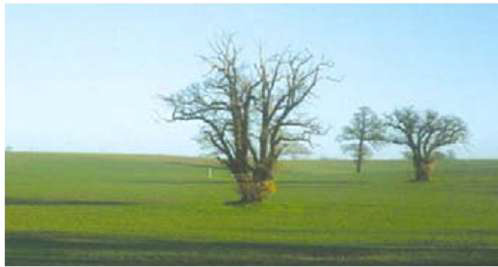
Changes in farming practices have meant that now in many parts of the UK only a few farmland ancient trees remain. If the remaining trees disappear we lose history, culture, wildlife and landscape beauty. The rate of loss in some places appears to be far greater than the development of new generations of ancient trees. Therefore every single remaining ancient tree is important and replacement trees are essential. Changes in farming and forestry in the past 100 years have meant that ancient ‘working’ trees are no longer so important for traditional rural products. However, ancient trees that are gnarled and hollow are historical landmarks and give local character to many of our most cherished landscapes.
Although they are a familiar sight to us, some experts believe these trees survive in such abundance nowhere else in Northern Europe and this makes us the custodians of landscapes of international importance.
GROWING OLD ADDS VALUE FOR WILDLIFE:
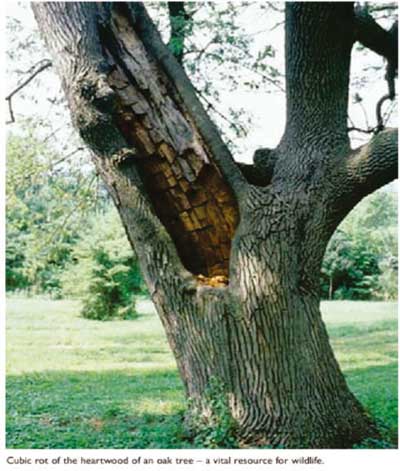
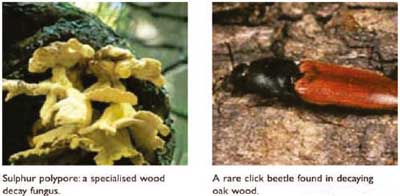
A sustainable population of ancient trees in the landscape is vital for the specialised wildlife dependent on them. It is the old wood and bark and the process of hollowing by fungi which are so important. In areas of low air pollution, rare lichens colonise ageing bark. Inside the tree, specialist fungi start the process of softening up the wood. Once the wood has started to decay, it becomes the habitat of other creatures such as rare insects. A succession of different fungi and insects colonise the changing conditions. They recycle the dead wood and its valuable minerals and nutrients back into the soil for the tree to reuse. It is believed that many of the rare species associated with old trees can only colonise new trees if they are within easy reach and are the right age or in the right condition. Ageing trees need to be nearby to provide the habitat for these species to move across to. Some of the rare species of fungi, bats, birds, lichens and insects associated with ancient and hollowing trees are protected by law. You may need specialist advice to find out if these species are present and how and when to undertake any tree work. For further information, go to www.ancient-tree-forum.org.uk
GETTING TO THE ROOT OF THE PROBLEM
SOME COMMON FARMING ACTIVITIES THAT AFFECT ANCIENT TREES:
1. Cultivation and ditching
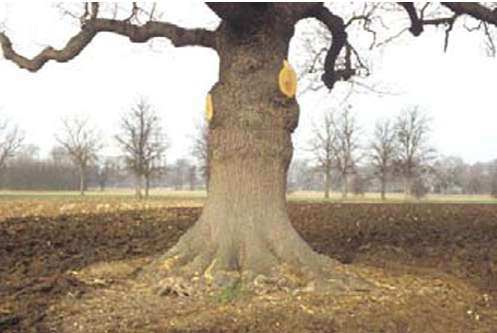
It is essential to the health and longevity of trees to protect their root ecosystems. But because roots are out of sight in the soil, the impact of our actions is often overlooked.
The root system of a tree is a very different shape to the outline of a tree above ground, it is not a mirror image. Most of the tree’s roots are typically within the top 600mm of the soil, with perhaps a few penetrating to twice this depth, although there is a lot of variation due to soil type and tree species. Roots typically spread out 1.5 to 2.5 times further than the radius of the canopy.
Deep ploughing damages roots and may lead to gradual loss of trees in an historic landscape. Depending on local conditions the root system may develop unevenly and grow out more on one side of the tree than the other. Even when root systems decline, as trees age and their canopy reduces, the root system may still extend a great distance from the trunk of the tree.
Cultivation, especially ploughing and ditching, damages roots and also the important mycorrhizal fungi linked to them.
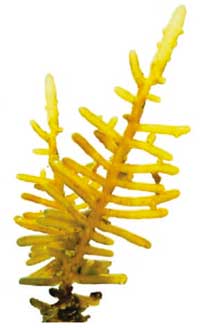
Most plants form mycorrhizal associations with fungi which live in the soil. Mycorrhizal fungi benefit trees by linking directly with tree roots to provide the equivalent of an extended root system. They gather essential nutrients otherwise inaccessible to the tree and act as a barrier to certain disease-causing organisms. These organisms may enter the tree if fertilisers and chemicals encourage the growth of non-mycorrhizal roots. Mycorrhizae help the tree to cope with extremes in growing conditions.
Compaction due to heavy vehicles or stacked materials also damages roots, affects the soil structure and may lead to prolonged periods of waterlogging or drying out in summer. As we do not know where the roots are, a precautionary approach should be taken even if the area currently allowed for by grants is less than ideal.
HOW CAN YOU HELP?
Create a root protection zone around each ancient tree 15 times the diameter of the tree trunk or 5 metres beyond the canopy, whichever is the greater, to avoid undue damage to root systems.
2. Fertilisers and animal medicines:
Mycorrhizal fungi and other micro-organisms may be harmed by chemicals such as fertilisers, pesticides and the excreted residues of veterinary medicines.
Lichens on the bark of ancient trees can be smothered or harmed if sprayed by chemicals or manure.
Nitrogen, phosphorus and potassium fertilisers may change soil structure over time especially in clay soils. This may help the spread of soilborne fungal diseases.
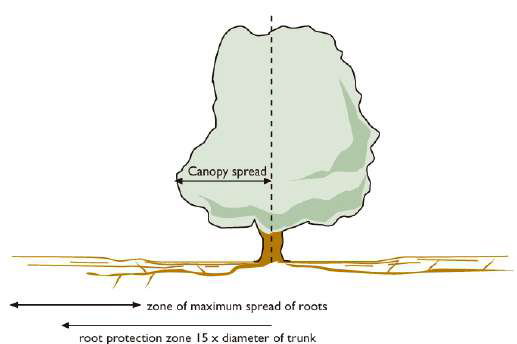
Diagram showing the minimum root protection zone compared with maximum root spread
HOW CAN YOU HELP?
- Avoid applying any fertilisers or pesticides near tree roots and trunks of ancient and mature trees.
- Make sure that animals treated with veterinary products are kept away from trees until the medicines have been excreted.
3. GRAZING
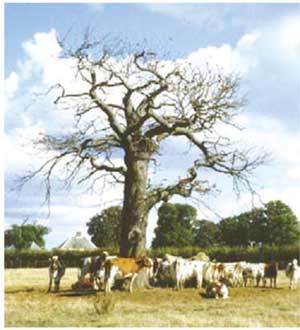
Many of our ancient trees have grown in grazed, unimproved pastures throughout their lives, but today, high numbers of larger and heavier animals can cause severe compaction and pollution. Where animals congregate under trees or herds of animals move regularly along narrow access routes they cause compaction. High levels of dung and urine can build up creating localised high nutrient levels which can damage beneficial root associations with fungi. Browsing damage to the bark may expose wood to pathogens. However, it is also important to control the growth of vegetation around trees. Some vegetation e.g. bracken, can create a high fire risk and a single incident may kill many trees. Too much vegetation will compete with the tree for light and nutrients, shade out important lichen communities or affect insects which need sunlit tree trunks.
HOW CAN YOU HELP?
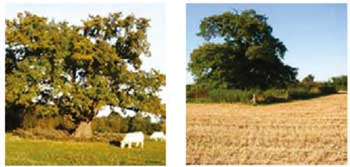
Tree ringed by cut hawthorn scrub to keep stock
from congregating under the canopy
Fencing around a tree to 15 times the diameter of this trunk to protect the roots in arable cultivation
However, they are still very important historically and will remain valuable for wildlife for many years to come.
- Limit the frequency and length of time, stock graze or congregate near ancient trees.
- Fence off trees from stock or provide physical barriers to prevent them congregating under important trees and provide alternative sources of shade.
- Locate supplementary feed, salt licks, drinking troughs and manure heaps away from ancient trees.
- Restrict vegetation that shades tree canopies, trunks or is a high fire risk e.g place slip rails in protective fencing to allow some grazing to control vegetation.
4. Retain mature and ancient trees alive and dead
Standing dead trees are valuable and may last for many years. The gradual breakdown of decaying wood recycles valuable minerals and other nutrients, some of which are taken up by mycorrhizal fungi. Retaining existing mature or young trees is important too as they will become the ancient trees of the future well before any new planting can get established. We have lost so many trees in recent decades that more planting of trees in fields and hedgerows is necessary. We need to establish many new trees to Tree ringed by cut hawthorn scrub to keep stock from congregating under the canopy. Fencing around a tree to 15 times the diameter of the trunk to protect the roots in arable cultivation. become the open grown trees of tomorrow and the ancients of the future. Open grown trees appear to have more chance of reducing their canopies naturally in old age, so they can survive much longer.
How can you help?
- Before any work takes place check whether the tree is protected by a Tree Preservation Order and that the work complies with protected wildlife legislation.
- Retain trees wherever possible, even dead trees. Consider alternatives such as reducing the canopy before making a decision that may result in a centuries old tree being felled. Felling to ground level is rarely necessary.
- Leave fallen branches and use them to protect trunks and roots from stock.
- Aim for a population of different aged trees to create a sustainable supply of ancient trees into the future.
- Plant more trees, especially oak and other native species suited to the site, taking into account historic features and landscape design.
- Mark and protect new trees in hedgerows, according to the guidance in the Tree Council’s Hedge Tree Campaign.
CHANGING THE WAY WE LOOK AFTER THE TREE ABOVE GROUND
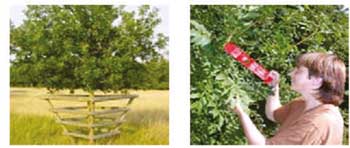
Future landscapes need more trees.
Mark and protect young trees to prevent them being cut back when the hedge is trimmed.
5. Follow best practice when cutting mature and ancient trees
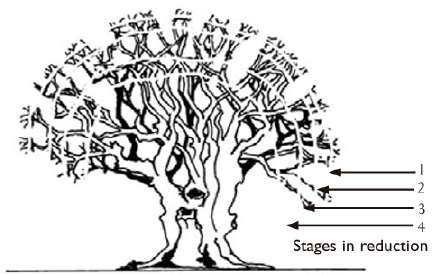
Pollards that have not been cut for many years (lapsed pollards) will have large, heavy branches and the trunk or bolling of the tree may not be able to support their weight. The tree may collapse in high winds. Planned reduction over a period of years may help prolong their lives. The removal of large limbs especially ones lower down may destabilise a tree.
HOW CAN YOU HELP?
- Seek professional advice when cutting ancient trees or lapsed pollards.
- Reduce trees only as much as is necessary to make them structurally sound.
- Plan reduction of canopies in stages (see diagram opposite).
- Wherever possible leave lower limbs intact but if essential, should be done by skilled workers.
- After cutting, manage the regrowth to ensure the tree does not become top heavy again.
- Leave torn or broken limbs to recover naturally.
- Leave fallen or cut material beside or near as possible to the tree.
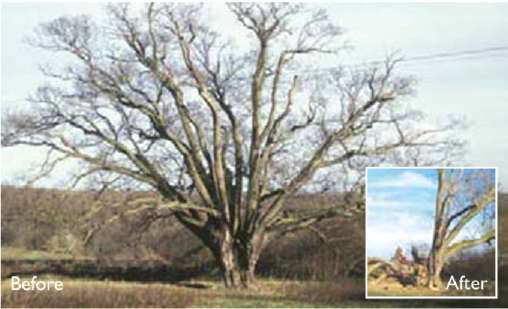
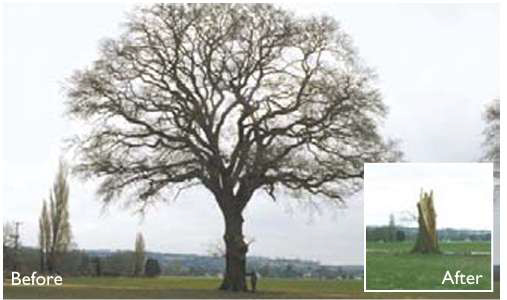
The reduction of the canopy may need to be phased over many years, depending on the vitality of the tree. The gradual reduction of the canopy allows the tree to slowly adapt and recover.
English Nature website.
WHO TO CONTACT AND WHERE TO GET MORE INFORMATION:
SOURCES OF FURTHER INFORMATION AND ADVICE:
For general and specific advice on ancient tree management and sources of funding, contact www.ancient-tree-forum.org.uk via the email enquiry link. There is a discussion forum for sharing of information, ideas and concerns. Alternatively phone the Woodland Trust information desk on 01476 581135.
This leaflet is the first in a series on the management of ancient trees. Further leaflets are planned covering the management of trees in historic landscapes, trees in relation to construction and the management of decaying wood habitats including ancient trees in woodland.
For further information about partner organisations go to their websites: www.nationaltrust.org.uk www.fwag.org.uk www.english-heritage.org.uk/parksandgardens www.english-nature.org.uk www.forestry.gov.uk www.ccw.gov.uk
To obtain tree tags for information on tree tagging, or to find a tree warden, contact the Tree Council www.treecouncil.org.uk This leaflet is available in Welsh as a pdf. Mae’r daflen hon ar gael yn Gymraeg fel pdf o wefan www.ancient-tree-forum.org.uk
Photographs – All images taken by Ted Green unless otherwise stated. Sulphur polypore: WTPL/David Lund; Click beetle: Roger Key; Tinted tree: Nöel Kingsley; Root tips: Andy Taylor; Fencing: John Clayton; Tree guard: Charlie Burrell; Mawley oak: Roy Finch; Tagging trees: The Tree Council; Diagram of tree reduction, Neville Fay (2004) Treework Environmental Practice The Woodland Trust, Autumn Park, Grantham, Lincolnshire, NG31 6LL Tel 01476 581111 Fax 01476 590808 www.woodland-trust.org.uk Ancient Tree Forum c/o The Woodland Trust, Autumn Park, Grantham, Lincolnshire, NG31 6LL Tel 01476 581135 Fax 01476 590808 The Woodland Trust is a registered charity, number 294344. A non-profit making company limited by guarantee. Registered in England number 1982873 The Ancient Tree Forum is a registered charity, number 1071012. The Woodland Trust logo is a registered trademark 2623 01/05