
Dr. A. D. Kholkute
Since 1999, I have shared an unbreakable bond with the Forest Department. Over the years, I have gained immense experience-but more importantly, I have learned deeply. Every forest, every animal and bird communicates with us indirectly-sometimes through actions, sometimes through subtle warnings. The key lies in understanding their language. In one sentence: “The forest is expressive.”
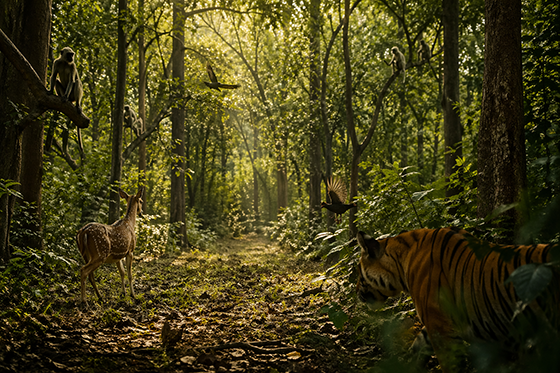
A forest is the green lung of nature-a vital source of oxygen. When we think of a forest, a picture naturally forms in our minds: tall trees, leaf-covered ground, a narrow trail disappearing into the distance… and an overall mysterious silence. Many believe that forests are silent. But are they really?
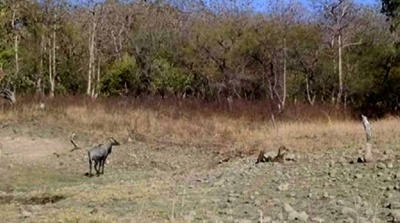
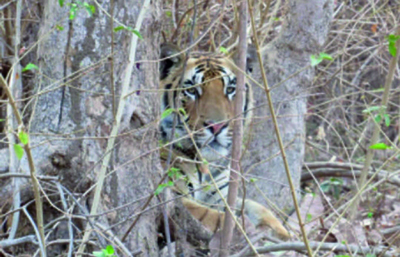
Spend some time in a forest during summer, and the answer slowly reveals itself. At noon, when the sun is overhead, the forest appears still. Trees seem motionless, bird calls reduce, and a strange calm spreads everywhere. But this is not dead silence-it is a living, alert, and constantly moving stillness.
If you sit quietly and listen carefully, subtle sounds begin to emerge from that silence-the rustle of dry leaves under a cautious animal, a distant warning call of a bird, the movement of monkeys on branches, or the soft whisper of the wind. Together, these sounds form the unique language of the forest.
This “silence” is actually the beginning of communication. In the forest, every creature is constantly alert because survival is a continuous struggle. No one is entirely safe. Every being depends on others, yet must remain cautious to protect itself. Silence in the forest does not mean safety. In fact, many times, silence signals danger.
Suddenly, bird calls stop… monkeys freeze… deer or sambar stand still, staring in one direction. All these signs point to one thing-a predator is nearby.
The tiger or leopard, masters of stealth, move silently and cautiously toward their prey. Their presence is rarely seen-but deeply felt. And it is the other animals that sense it first.
The alarm call of a sambar is one of the most powerful warnings in the forest. It travels far, alerting others instantly. Monkeys create chaos in the trees. Birds fly off or give specific calls. But often, before all this happens, there comes a phase of complete silence.
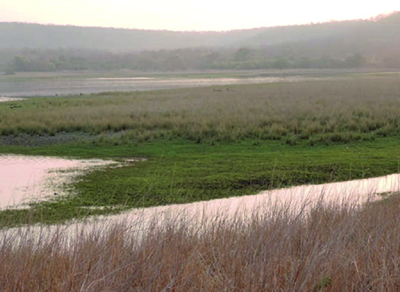
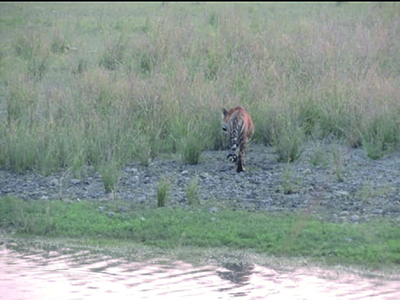
That silence itself is nature’s warning. I have personally experienced this many times. While sitting near a waterhole, observing wildlife, I have seen moments when all sounds suddenly stopped. For a few seconds, nothing moves. Time seems to pause. And then, slowly, a realization sets in-something significant is about to happen. You may not see it, but you feel it-the tiger is near. Sometimes it hides in the grass, sometimes it waits near water. Even when unseen, every creature in the forest senses its presence. This is the true school of the jungle, where every animal learns continuously through experience. A tiger learns to hunt from its mother-only then does it become skilled. Every forest creature is fluent in this language of nature. They understand every sound, every scent, every movement-because for them, it is not just information, but a matter of life and death. Humans, however, have drifted away from this language. Lost in the noise of cities, we have forgotten to notice nature’s subtle signals. But when we enter a forest, this sensitivity slowly returns. The forest teaches us: Be still… Listen… Understand. A summer forest may appear dry, motionless, and silent-but behind that silence, an entire cycle of life continues. Every moment, someone is searching for water, someone is hunting, and someone is trying to survive. This silence is not inactivity-it is an intense awareness of life. After the harsh summer, when the first rains arrive, the same forest bursts into life again. Birds sing louder, trees sprout fresh leaves, and life renews itself.
But behind this revival lies the tough test of summer-the same silence, the same struggle. That is why the silence of the forest is mysterious. It appears calm, yet within, it is intensely alive. It is the language of nature-understood only through patience and experience. There is an unwritten rule in the forest:The alert survive. The careless perish. “Jo darr gaya, woh mar gaya” – this is not just a movie line; in the jungle, it is reality. So the next time you visit a forest and feel its silence-do not ignore it. Pause… Listen… Understand… Because in truth-The forest is never silent. It is alive every moment.

Author
Retired Wildlife Veterinarian,
Nagpur (India)