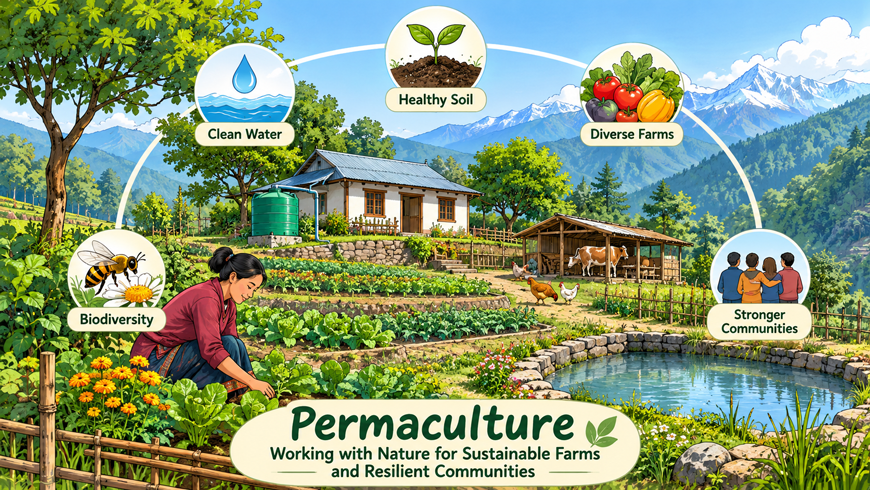
Working with Nature for Sustainable Farms and Resilient Communities
-Rashmi, Abhishek Sikdar
Permaculture is a design approach that connects soil, water, crops, trees, animals and people so that each part of the farm supports other parts. It is not a fixed package of techniques. The aim is to observe local conditions, reduce waste, recycle resources, diversify production and build systems that remain useful over the long term.
Why Permaculture Matters
Agriculture depends on living soil, water, sunlight, biodiversity and human knowledge. Yet farming systems can become vulnerable when they rely heavily on a narrow range of crops, purchased inputs or poorly managed water. Permaculture offers a different way of thinking: design the farm as an ecosystem rather than as a collection of isolated enterprises.
The term emerged from the idea of “permanent agriculture” and later expanded to include sustainable human settlements. In practice, permaculture begins with observation. Where does rainwater flow? Which parts of a farm are sunny or shaded? Which biomass is currently treated as waste? Which crops, trees and animals can complement one another? The answers differ from place to place, so good permaculture is necessarily site-specific.
Three ethics: a simple foundation
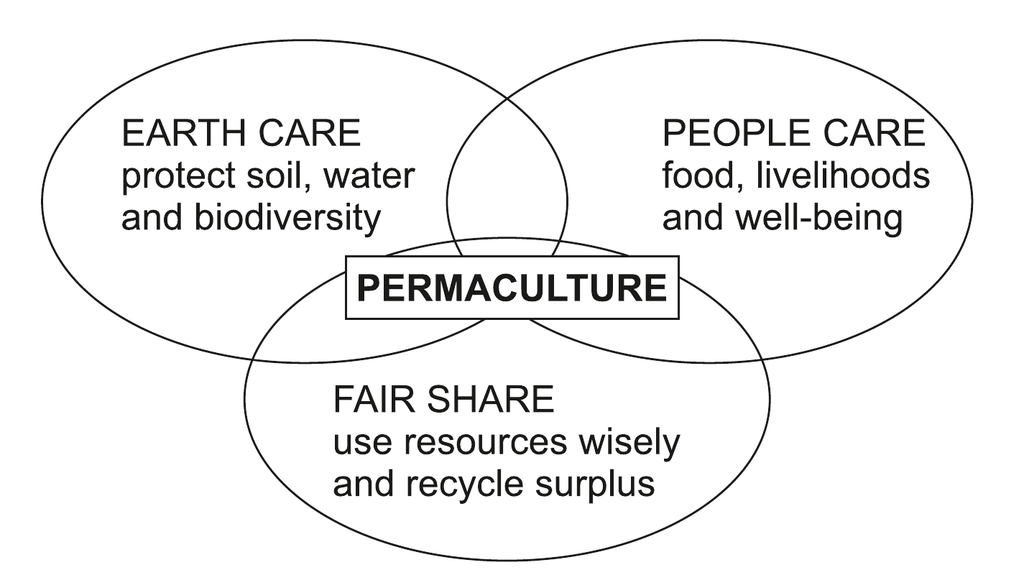
Earth Care emphasizes protection and regeneration of soil, water and biodiversity. People Care recognizes food, livelihoods, health, skills and community well-being. Fair Share encourages responsible use of limited resources and the return of surplus materials to useful cycles. These ethics are broad guides rather than farm prescriptions.
Permaculture and agroecology
Permaculture is distinct from agroecology, but the two share several practical themes. FAO’s agroecology framework highlights diversity, synergies, recycling, efficiency and resilience, along with knowledge sharing, social values, food traditions, governance and circular economies. These ideas help explain why diversified crop-tree-livestock systems, composting, water conservation and local knowledge are frequently discussed alongside permaculture.
From Principles to Farm Practice
| DESIGN IDEA | PRACTICAL FARM INTERPRETATION |
| Observe and interact | Map sunlight, slope, soil moisture, winds, water flow and existing biodiversity before changing the farm. |
| Catch and store resources | Harvest rainwater; conserve soil moisture; retain useful biomass and organic matter. |
| Obtain useful yields | Design for food, fodder, fuel, fibre, manure, honey or income rather than aesthetics alone. |
| Use renewable resources | Prefer locally available biomass, biological processes and renewable inputs where practical. |
| Produce little waste | Compost biodegradable residues; use crop residues appropriately; repair and reuse materials. |
| Design from patterns to details | First understand slope, drainage, access and household needs; then decide crop beds and structures. |
| Integrate rather than segregate | Connect crops, trees, livestock, pollinators, compost and water management. |
| Use diversity | Combine species, varieties and enterprises to spread risk and use ecological niches. |
| Use edges and small spaces | Farm boundaries, terrace risers and kitchen-garden margins can support useful vegetation. |
| Adapt and respond to change | Treat the farm as a learning system and modify designs as climate, labour and markets change. |
Table 1. Selected permaculture design ideas and their practical interpretation.
A central lesson is that a technique becomes valuable only when it fits the farm. A pond in the wrong place, a tree that excessively shades crops or an animal enterprise without adequate fodder can create new problems. Permaculture therefore rewards careful design more than simply accumulating techniques.
Nothing is waste: closing farm loops
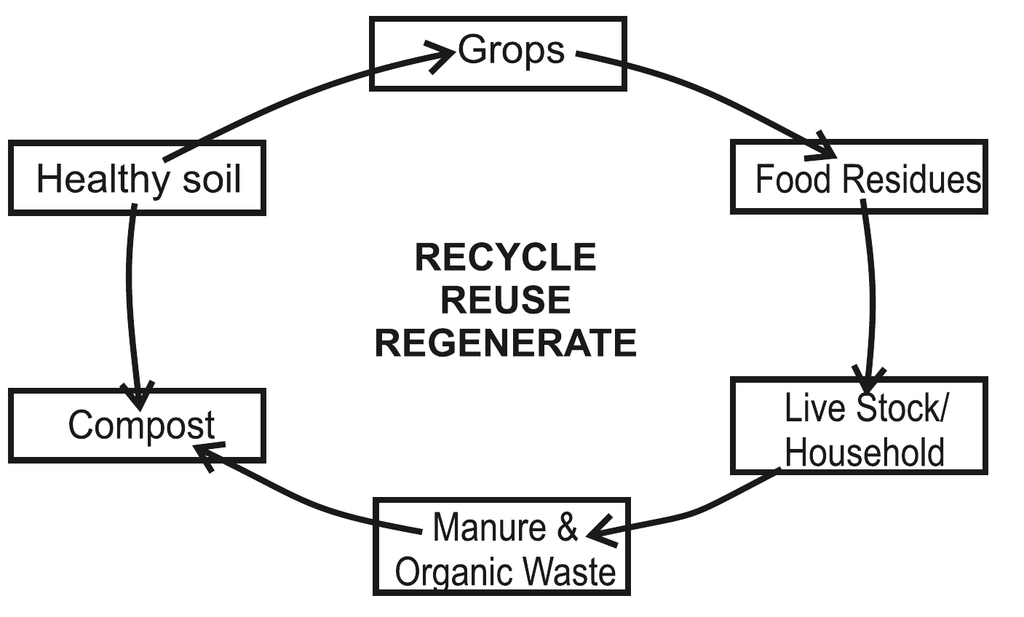
Figure 2. Circular use of biomass and nutrients in an integrated farm.
Crop residues may feed livestock; manure can enter compost; compost returns organic matter and nutrients to soil; healthy soil supports the next crop. Kitchen biodegradable waste and tree leaves can also join this cycle. Recycling does not remove the need for nutrient budgeting, but it can reduce avoidable losses and make better use of resources already present on the farm.
Water: Slow It, Spread It, Store It
Water management is especially important in mountain agriculture. Intense rainfall on sloping land can generate rapid runoff, soil erosion and nutrient loss, while dry periods may follow soon afterwards. A permaculture-oriented design tries to keep useful rainfall in the landscape without creating waterlogging or slope instability.
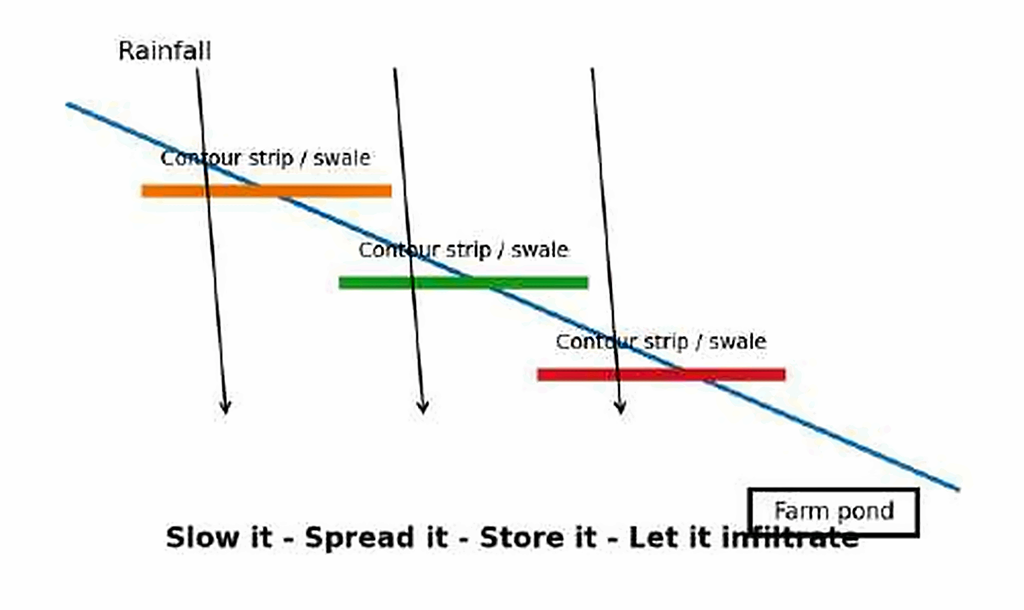
Figure 3. Conceptual water management on a slope. Structures require site-specific technical design.
| PRACTICE | ROLE IN WATER MANAGEMENT |
| Rooftop rainwater harvesting | Stores relatively clean roof runoff for appropriate household or garden uses, depending on treatment and local guidance. |
| Mulching | Reduces direct soil exposure and can lower evaporation while adding organic matter. |
| Vegetative contour barriers | Slow runoff and help trap sediment when correctly established. |
| Contour trenches / swales | Can intercept and infiltrate runoff on suitable sites; inappropriate design on steep or unstable slopes may be risky. |
| Farm pond / storage tank | Provides stored water for supplementary irrigation where safe siting and lining are feasible. |
| Terrace maintenance | Well-maintained terraces and drainage reduce uncontrolled flow and erosion. |
Table 2. Water-conservation options that can form part of a permaculture design.
A Himalayan connection
The Himalaya already contains a rich history of locally adapted water management. Traditional systems such as naulas and dharas are associated with springs and community water use, while chals and khals are linked with local water harvesting in parts of Uttarakhand. Such practices should not automatically be labelled “permaculture”; rather, they demonstrate the value of observing landscape processes, conserving water and drawing on local knowledge.
The safest principle is simple: water must be slowed and stored only where the slope, soil, drainage and geology permit. On steep terrain, engineering advice may be necessary before constructing trenches, ponds or other structures.
Diversity: Let the Farm Perform Many Jobs
Natural ecosystems contain layers, niches and many interacting species. Farms can use the same logic through mixed cropping, crop rotation, agroforestry, kitchen gardens, livestock integration and flowering vegetation. Diversity can spread production risk and provide food or income at different times of the year.
Agroforestry: trees as working farm components
A MULTI-LAYERED FARM
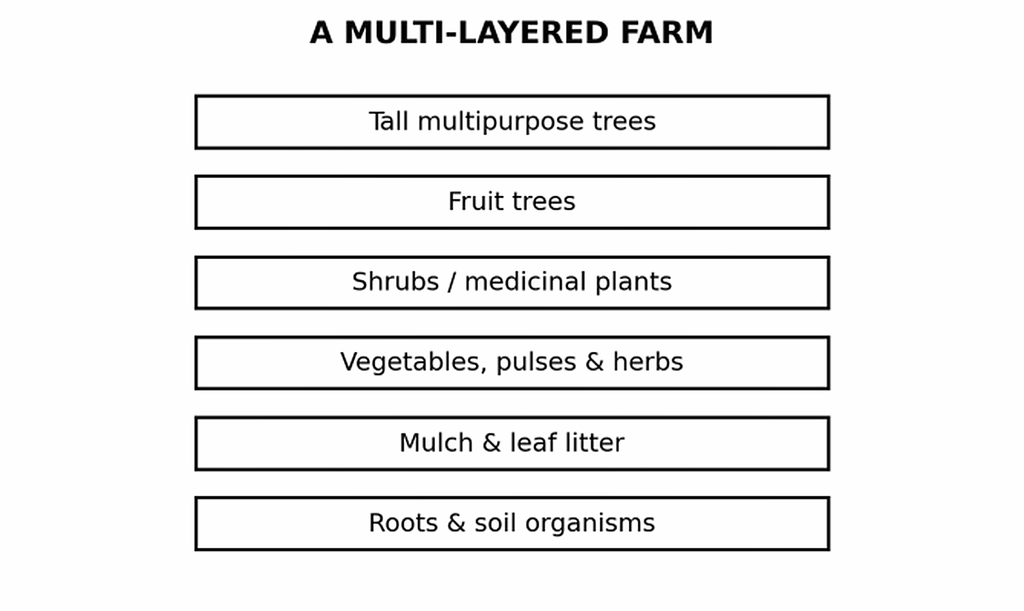
Figure 4. A simplified multi-layered agroforestry concept.
Trees can provide fruit, fodder, fuelwood, leaf biomass, shade, habitat and slope protection. Deep-rooted species may access soil layers beyond annual crops. But species choice matters: farmers need locally adapted trees whose shade, root competition, water use and management requirements fit the crop system.
Mixed cropping and the Barahnaja example
Traditional Himalayan agriculture offers useful examples of diversity. Barahnaja, associated with Uttarakhand, is a multi-cropping tradition in which several cereals, millets, pulses, oilseeds and other crops may be grown together. Its exact crop composition varies by locality. The important design lesson is not to copy a fixed list of crops, but to understand complementary relationships, household food needs, local seed diversity and risk spreading.
| DIMENSION | Possible Expression On A Himalayan Farm |
| Crop diversity | Mixed cereals, millets, pulses, vegetables and locally adapted varieties |
| Tree diversity | Fruit, fodder and multipurpose trees on suitable boundaries or terraces |
| Animal integration | Cattle, goats, poultry or bees where feed, labour and management are adequate |
| Habitat diversity | Flowering strips, hedges, uncultivated refuges and useful native vegetation |
| Income diversity | Food crops plus fruits, milk, honey, nursery plants, compost or value-added products |
Table 3. Different dimensions of farm diversity.
SOIL, COMPOST, LIVESTOCK AND POLLINATORS
Keep the soil covered
Bare soil is exposed to raindrop impact, erosion, temperature extremes and rapid moisture loss. Organic mulch – such as clean straw, dry leaves or suitable crop residues – can protect the surface and gradually contribute organic matter. Cover crops and living vegetation can provide similar protection where appropriate.
Compost: turn biodegradable material into a resource
Farmyard manure, leaves, crop residues and biodegradable kitchen materials can be composted rather than discarded. Good composting requires an appropriate balance of moist and dry materials, aeration and time. Diseased plant material, plastics, glass, chemicals and unsuitable waste should be kept out. Vermicomposting can be added where temperature, moisture and earthworm management are suitable.
Animals should have more than one function
In an integrated system, livestock can provide milk, eggs, manure, draught power or income, while consuming selected crop by-products. Integration is beneficial only when fodder supply, housing, veterinary care, labour and manure handling are adequate. Too many animals can shift the system from recycling to resource pressure.
Bees: small partners, large ecological value
Flowering crops, fruit trees, hedgerows and wild plants provide forage for bees and other pollinators. Beekeeping can complement diversified farms through honey and other hive products, while pollination supports many crops and wild plants. Pesticide use, forage gaps, disease and poor hive management can undermine these benefits, so pollinator-friendly farming requires more than simply placing hives.
| COMPONENT | DESIGN APPROACH | POTENTIAL BENEFIT |
| Soil | Mulch, compost, cover, reduced unnecessary disturbance | Moisture conservation, organic matter, biological activity |
| Livestock | Link feed resources with manure recycling | Food/income plus nutrient cycling |
| Pollinators | Maintain flowering resources and safe habitat | Pollination, biodiversity and possible hive products |
| Crop residues | Feed, mulch or compost according to residue quality | Lower waste and improved resource use |
| Kitchen garden | Locate near household for | Fresh vegetables, herbs and efficient use of small spaces |
Table 4. Connecting biological components so that each performs multiple functions.
A Model Permaculture Plan for a Small Himalayan Holding
Consider a hypothetical terraced household farm. The area closest to the house is used for vegetables, herbs and frequently harvested crops. A compost unit is placed where household biodegradable waste and livestock manure can be managed conveniently. Rooftop runoff is directed to a safe storage tank. Fruit trees and selected fodder trees occupy suitable positions where they do not create excessive shade. Field crops are diversified across terraces, while flowering vegetation supports pollinators.
| Farm zone | Possible components | Main purpose |
| Near the house | Kitchen garden, herbs, nursery, compost | Frequent harvesting and daily management |
| Farm buildings | Roof-water collection, livestock shed, manure handling | Capture water and nutrients close to source |
| Productive terraces | Mixed crops, rotations, legumes, vegetables | Food, income and risk spreading |
| Boundaries / risers | Suitable grasses, fodder shrubs, flowers, selected trees | Slope cover, fodder, habitat and biomass |
| Lower safe point | Pond or tank where technically feasible | Supplementary irrigation and water storage |
| Less-managed patch | Native vegetation / | Habitat and ecological functions |
Table 5. Example zoning for a small Himalayan farm
Economic opportunities and realistic cautions
Permaculture is often promoted for ecological benefits, but farmers ultimately need systems that support household livelihoods. Diversification can create multiple products – vegetables, fruits, pulses, milk, eggs, honey, compost or planting material and recycling can reduce some purchased inputs. However, establishment costs, labour demand, delayed returns from trees, wildlife damage, market access and technical skill can affect profitability.
For this reason, farm assessment should go beyond yield. Useful indicators include total production value, paid and family labour, input expenditure, net farm income, household food consumption, water use, soil organic matter, enterprise diversity and the stability of returns across seasons. A gradual transition is often more practical than redesigning an entire farm at once.
Start small
A farmer might begin with one compost unit, one mulched vegetable bed, a small roof-water system, a flowering strip for pollinators or a better crop rotation. Observe the result, record labour and costs, and expand only when the practice proves useful.
The Way Forward: Designing with Nature
Permaculture is most useful when treated as a way of thinking rather than as a fashionable collection of structures. Its central question is: can the farm be designed so that water, nutrients, biodiversity, labour and knowledge circulate more effectively and each component supports several functions?
For the Indian Himalayan Region, this perspective can complement agroecology, agroforestry, organic nutrient management, climate-resilient agriculture and traditional ecological knowledge. Demonstration farms, farmer-to-farmer learning, local nurseries, pollinator-friendly practices, careful water design and economic monitoring can help distinguish practices that genuinely work from those that only look attractive on paper.
Traditional systems should be approached respectfully. Barahnaja, terrace farming, local water-management practices and crop-livestock-forest linkages arose from specific histories and environments. Permaculture can learn from them without claiming them as its own. Equally, scientific evidence can help test productivity, labour requirements, soil effects, water outcomes and economic viability.
References
FAO. (2018). The 10 Elements of Agroecology: Guiding the Transition to Sustainable Food and Agricultural Systems. Food and Agriculture Organization of the United Nations, Rome.
FAO. Agroecology Knowledge Hub. The 10 Elements of Agroecology: diversity, synergies, efficiency, recycling, resilience, co-creation of knowledge, human and social values, culture and food traditions, responsible governance, and circular and solidarity economy.
Holmgren, D. (2002). Permaculture: Principles and Pathways Beyond Sustainability. Holmgren Design Services.
Mollison, B. (1988). Permaculture: A Designer’s Manual. Tagari Publications.
Mollison, B., & Holmgren, D. (1978). Permaculture One: A Perennial Agriculture for Human Settlements. Transworld Publishers.
Altieri, M.A. (1995). Agroecology: The Science of Sustainable Agriculture. CRC Press.
Gliessman, S.R. (2015). Agroecology: The Ecology of Sustainable Food Systems (3rd ed.). CRC Press.
Lohani, J.K., & Joshi, A. (2026). Baranaja Multicropping Indigenous System of Uttarakhand Himalaya as a Model of Sustainable Agriculture and Food Security. In Advances in Multidisciplinary Research and Innovation, pp. 256-265.


Authors are:
Centre for Socio-Economic Development
G.B. Pant National Institute of Himalayan Environment
Kosi-Katarmal, Almora, Uttarakhand