A Case Study of Dowhill, Kurseong, West Bengal
Indian Institute of Forest Management, Bhopal
– Devesh Pandey, IFS, Prof. S.P. Singh
BACKGROUND OF THE STUDY
Ecotourism focuses on preserving natural environment and wildlife, providing educational and recreational opportunities for visitors. It is focused on responsible travel to natural areas and plays an important role in revenue generation for local communities, authorities, and state/central government.
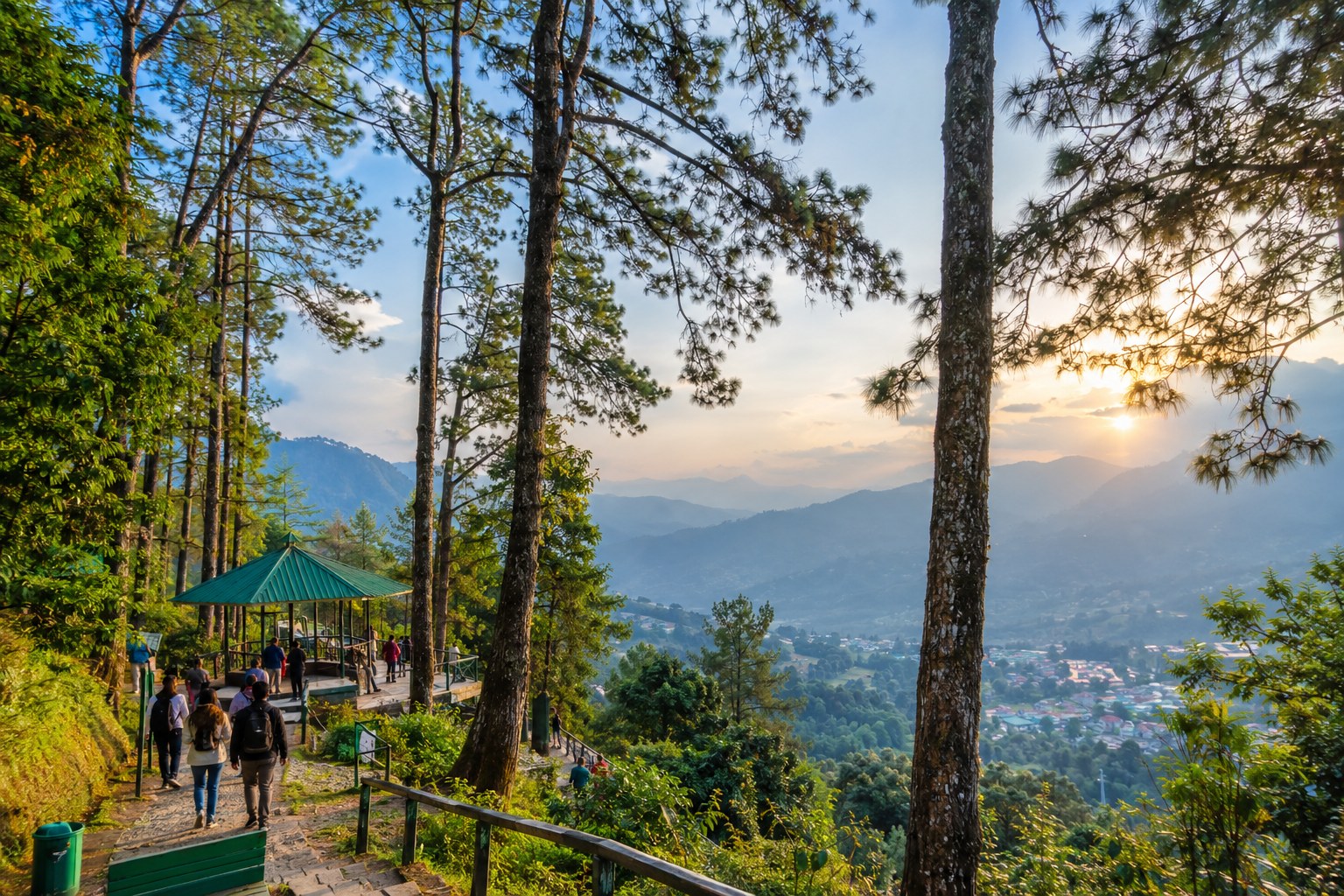
This site is located in DowHill, Kurseong, Darjeeling, West Bengal, India. It is one of the latest sites developed in 2024 in an area of 1 hectare. A popular ecotourism destination in Kurseong, after declaration as an eco-tourism site, more than one lakh tourists have visited during last year, and the trend continues to increase.
Ecotourism activities at Dowhill include nature walks in the pine forest area. Visitors can learn about wildlife, conservation efforts, and visit the interpretation centre museum.
KURSEONG FOREST DIVISION – CONTEXT
The Kurseong Forest Division, located in the Darjeeling district of West Bengal, forms an integral part of the ecologically sensitive Eastern Himalayan region. The division is characterized by steep mountainous terrain, dense forest cover, rich biodiversity, and a unique socio-ecological setting.
Eco-tourism has emerged as an important conservation-oriented initiative aimed at harmonizing environmental protection with sustainable development. It encourages appreciation of natural landscapes and cultural heritage while ensuring minimal ecological disturbance.
The initiative seeks to generate alternative and supplementary livelihood opportunities for forest-dependent communities, thereby reducing pressure on forest resources. This report documents the scope, implementation, impacts, and future prospects of eco-tourism activities in Kurseong Forest Division.
KINDS OF TOURISM
Eco-Tourism
Responsible travel that minimizes impact on the environment. Eco-tourists visit natural areas such as national parks, rainforests, and wildlife sanctuaries.
Adventure Tourism
Explores new places, often challenging or remote environments. Includes hiking, camping, trekking, mountain biking, whitewater rafting, and skydiving.
Cultural Tourism
Focuses on visiting historical sites, museums, art galleries, and cultural attractions. A great way to learn about different cultures and traditions.
Nature Tourism
Traveling to natural places to live in harmony with the natural world and enjoy them, without necessarily creating local employment.
Objectives of the Study
Preliminary Objectives
- To assess benefits of economic valuation of ecotourism and local communities.
- To find out how ecotourism revenue can create a stable source of income for the authority.
- To study the economic benefits of ecotourism, including spending on lodging, food, and transportation.
- Conservation of forest ecosystems, wildlife habitats, and biodiversity through regulated, low-impact tourism practices.
Secondary Objectives
- Promotion of environmental awareness, nature education, and conservation ethics among tourists, students, and local stakeholders.
- Creation of sustainable livelihood opportunities for forest-fringe communities through community-based eco-tourism models.
- Reduction of dependency on forest produce by providing alternative income-generating avenues.
- Strengthening participatory forest management through active involvement of Joint Forest Management Committees (JFMCs).
PROFILE OF THE STUDY AREA
The Kurseong Forest Division falls within the Eastern Himalayan bio-geographic zone and possesses high ecological and conservation significance.
Forest Type
Mixed broad-leaved forests, temperate forests, and patches of coniferous vegetation, particularly pine forests.
Biodiversity
Diverse flora and fauna including birds, butterflies, small mammals, and medicinal plants.
Climate
Temperate climate with high rainfall and pleasant weather conditions — suitable for nature-based tourism throughout the year.
Human Interface
Several forest villages and tea garden areas in close proximity to forest land, requiring balanced conservation and development.
METHODOLOGY
Travel Cost Method (TCM)
Based on the assumption that the value of a recreational site is reflected in the amount of money people are willing to spend to travel to and visit the site (cost of transportation, lodging, food, and other expenses).
Tourism Expenditure Method
Based on the assumption that economic value of ecotourism equals the sum of direct, indirect, and induced economic impacts of visitor spending, providing a more complete picture.
Data Collection
- Both primary and secondary data collected through structured questionnaire.
- 100 respondents interviewed after pre-testing of questionnaire.
- 7 shopkeepers surveyed to assess the impact of eco-tourism before and after declaration.
- Key informants: tourists entering the Eco-tourism site of Dow-Hill.
- Data compilation, tabulation, and simple statistical techniques used for interpretation.
TOURISM EXPENDITURE METHOD:
The Tourism Expenditure Method was based on the assumption that economic value of ecotourism is equal to the sum of the direct, indirect, and induced economic impacts of visitor spending.
Direct Impact: Money spent by tourists directly at the site – tickets, food, lodging, transport.
Indirect Impact: Economic activity generated in supply chains supporting tourism businesses.
Induced Impact: Spending by employees of tourism businesses in the local economy.
This method provides a more complete picture of the economic value of ecotourism than the Travel Cost Method alone.
DATA ANALYSIS:
Tourist Survey Results & Visitor Profile
Total Respondents: 100 Tourists | 7 Shopkeepers
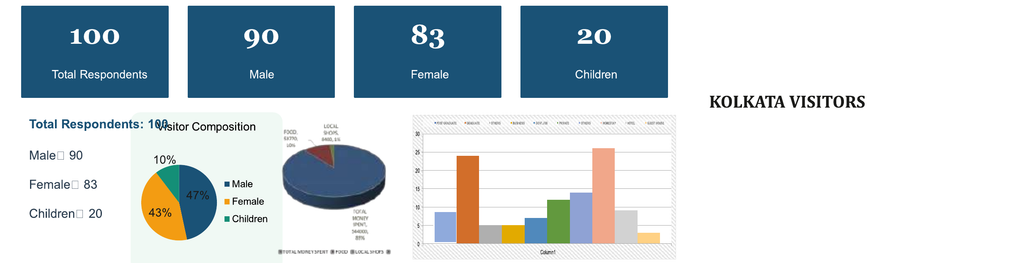
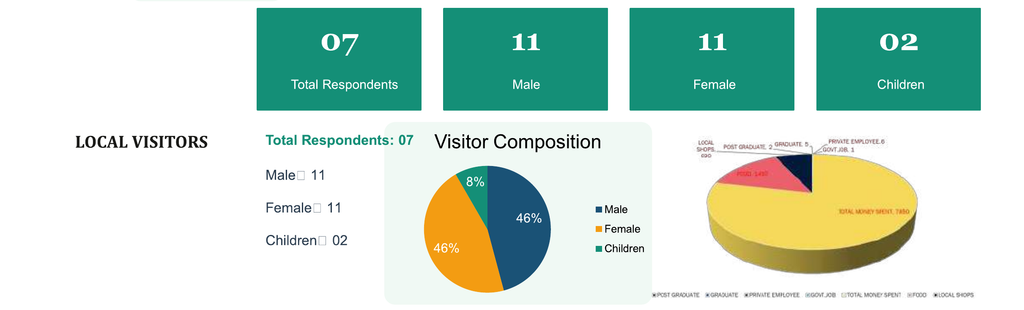
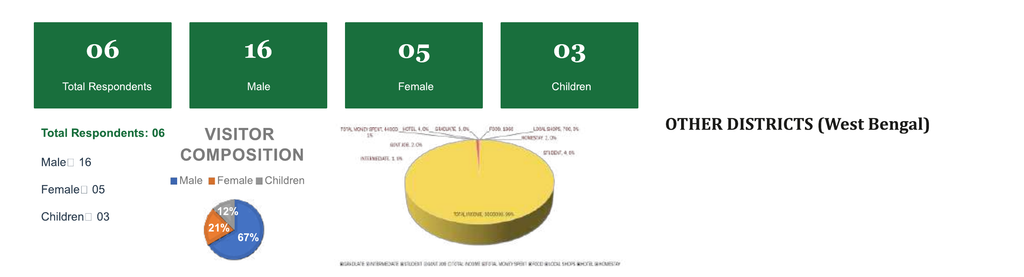
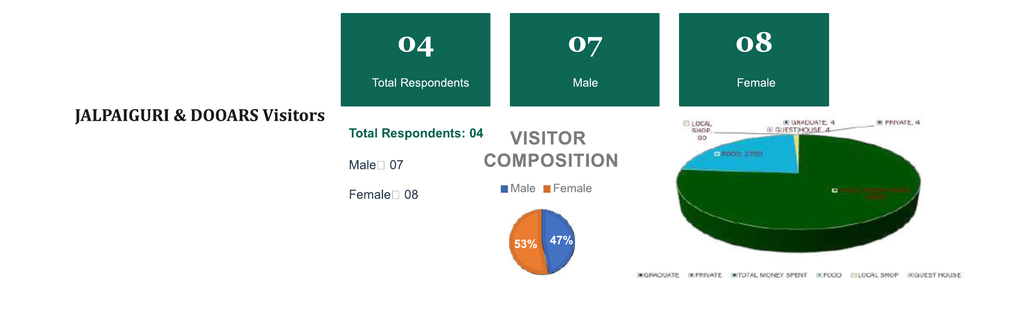
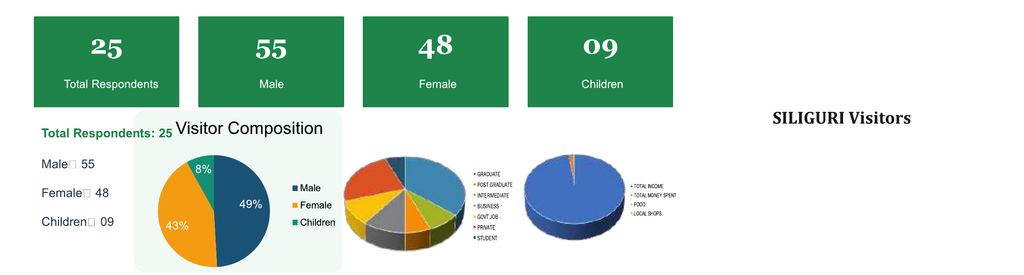
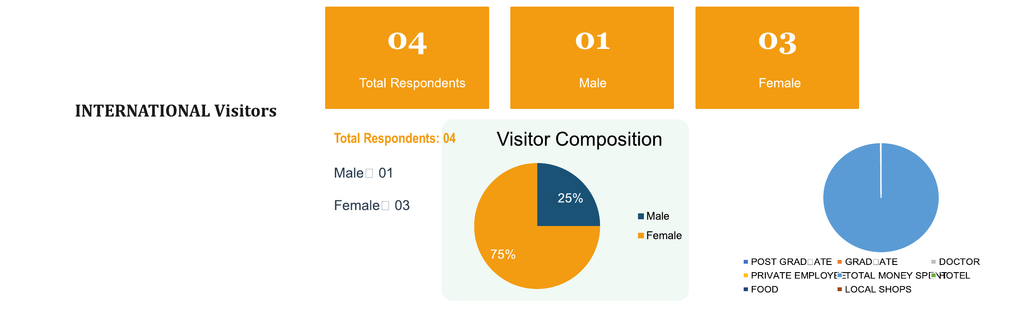
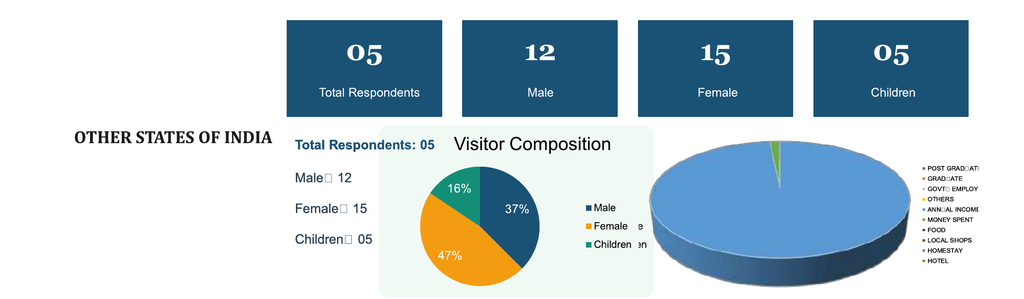
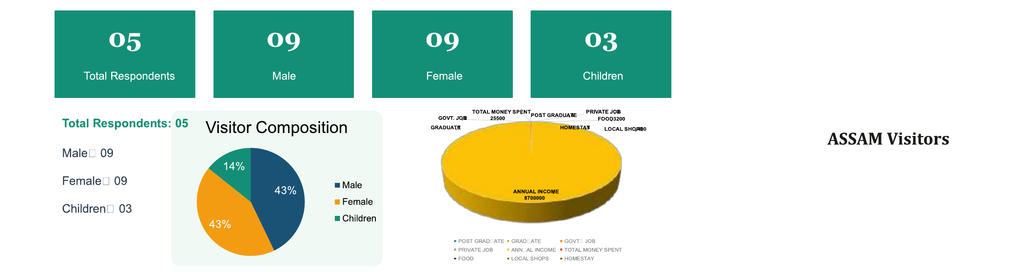
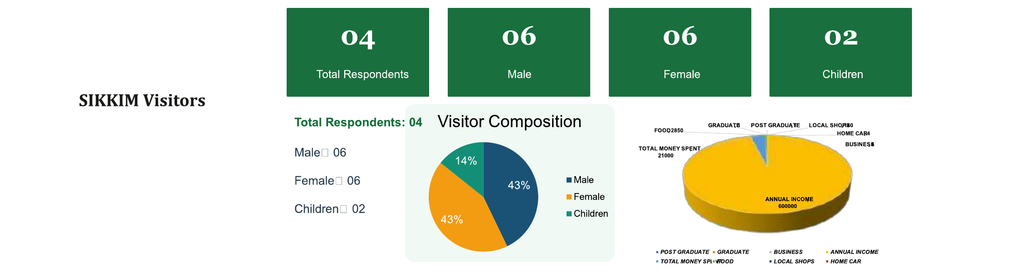
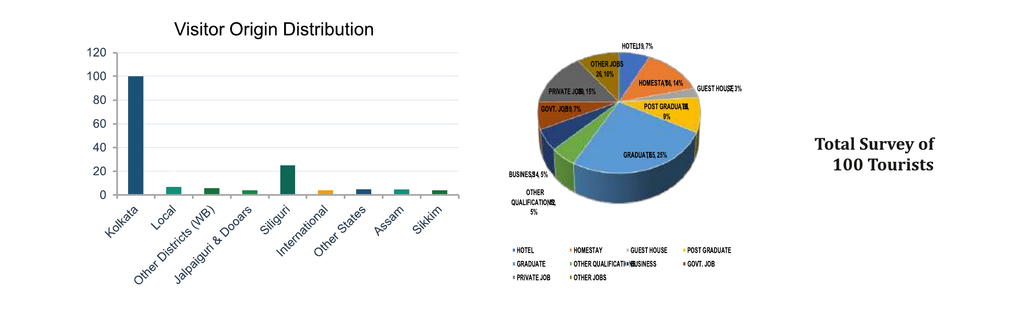
| Visitor group | Total Respondents | Male | Female | Children | Visitor Composition (Male / Female / Children) |
| KOLKATA VISITORS | 100 | 90 | 83 | 20 | 47% / 43% / 10% |
| LOCAL VISITORS | 07 | 11 | 11 | 02 | 46% / 46% / 8% |
| OTHER DISTRICTS (West Bengal) | 06 | 16 | 05 | 03 | 67% / 21% / 12% |
| JALPAIGURI & DOOARS Visitors | 04 | 07 | 08 | – | 47% / 53% (Male / Female) |
| SILIGURI Visitors | 25 | 55 | 48 | 09 | 49% / 43% / 8% |
| INTERNATIONAL Visitors | 04 | 01 | 03 | – | 25% / 75% (Male / Female) |
| OTHER STATES OF INDIA | 05 | 12 | 15 | 05 | 37% / 47% / 16% |
| ASSAM Visitors | 05 | 09 | 09 | 03 | 43% / 43% / 14% |
| SIKKIM Visitors | 04 | 06 | 06 | 02 | 43% / 43% / 14% |
Total Survey of 100 Tourists
Pie chart (percentages as legible in the source):
| Category | Share |
| Hotel | 7% |
| Homestay | 14% |
| Guest House | 3% |
| Post Graduate | 9% |
| Graduate | 25% |
| Other Qualifications | 5% |
| Business | 5% |
| Govt. Job | 7% |
| Private Job | 15% |
| Other Jobs | 10% |
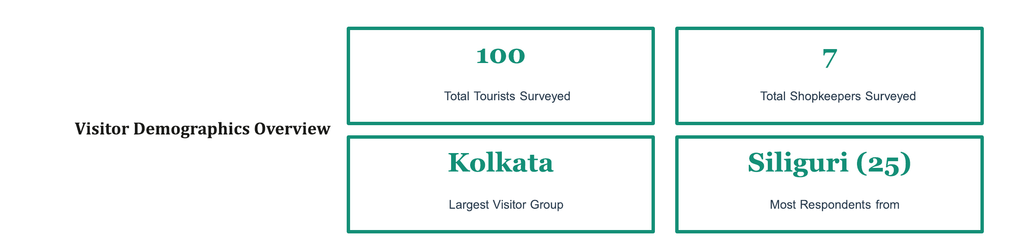
Visitor Demographics Overview
| Total Tourists Surveyed | 100 |
| Total Shopkeepers Surveyed | 7 |
| Largest Visitor Group | Kolkata |
| Most Respondents from | Siliguri (25) |
Shopkeeper Analysis – Category
| Sl. | Name of Shop | Category | Year Opened |
| 1 | Wake and Bake | ST | 2024 |
| 2 | Subhash Food Centre | General | 2024 |
| 3 | Meals on Wheels | ST | 2022 |
| 4 | Dowhill Tea Corner | ST | 2003 |
| 5 | Fine and Fine Bites | ST | 2015 |
| 6 | Flavour Zoom Fast Food | OBC | 2023 |
| 7 | Pine Tree Delight Fast Food Corner | OBC | 2023 |
Size of Family Members – Shopkeepers
| Age Group (years) | Male (M) | Female (F) | Total |
| Up to 10 | 1 | – | 1 |
| 10–20 | 3 | – | 3 |
| 20–30 | 3 | 2 | 5 |
| 30–40 | – | 1 | 1 |
| 40–50 | 4 | 5 | 9 |
| 50–60 | 1 | 3 | 4 |
| 60 and above | 2 | 3 | 5 |
| Total | 14 | 14 | 28 |
Income of Shopkeepers – Before & After Eco-Tourism
Monthly Income Comparison (₹)
| Shop | Before (₹) | After (₹) |
| Wake and Bake | 2,500 | 4,000 |
| Subhash Food Centre | 2,000 | 4,000 |
| Meals on Wheels | 8,000 | 20,000 |
| Dowhill Tea Corner | 2,000 | 8,000 |
| Fine and Fine Bites | 900 | 2,000 |
| Flavour Zoom Fast Food | 500 | 1,000 |
| Pine Tree Delight | 500 | 1,000 |
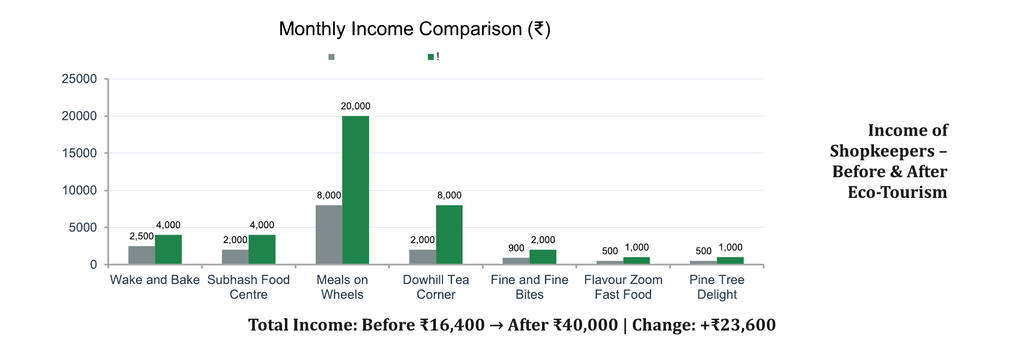
Total Income: Before ₹16,400 → After ₹40,000 | Change: +₹23,600
Menu of All Shops at Dowhill – Rate List
| Item | Rate (₹/unit) | Item | Rate (₹/unit) |
| Tea | 10 | Plain Roti (per piece) | 15 |
| Coffee | 20 | Egg Items | 20 |
| Veg Momos | 50 | Soup | 50 |
| Chile Momos | 70 | Fried Rice (Veg/Egg) | 60–80 |
| Maggi | 40 | Water (500ml/1L) | 10, 20 |
| Dum Aloo | 20 | Cold Drinks | 25 |
| Chicken Momos | 70 | Juice | 10 |
| Thupka Veg | 60 | Pani Puri (5 pieces) | 20 |
| Maggi with Egg | 60 | Shya Faley | 40 |
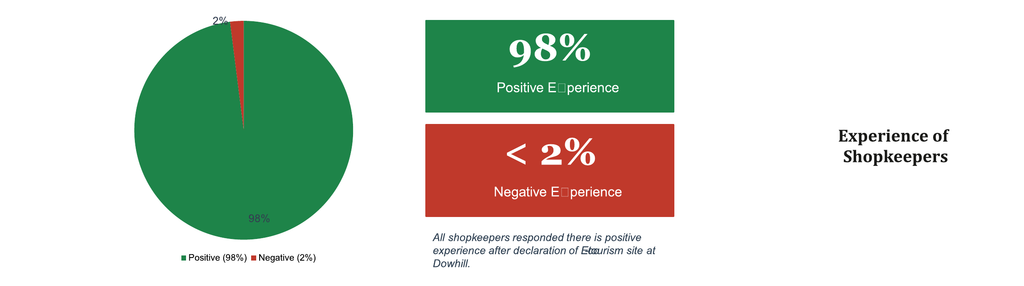
Experience of Shopkeepers
98% Positive Experience · < 2% Negative Experience (pie chart: Positive 98%, Negative 2%)
All shopkeepers responded there is positive experience after declaration of Ecotourism site at Dowhill.
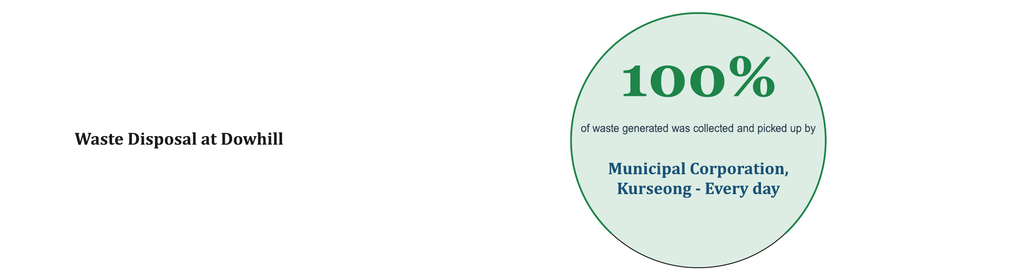
Waste Disposal at Dowhill
100% of waste generated was collected and picked up by Municipal Corporation, Kurseong – Every day.
Strategies Suggested by Shopkeepers
| Strategy | Percentage |
| Making Ecotourism spot of Dow Hill with the assistance of forest department a high level long term plan | 95% |
| Designed to achieve a major goal by allocating resources and defining a unique approach | 88% |
| Involving priorities setting | 85% |
| Making key decisions | 85% |
| Creating competitive advantage for income enhancement through incentives and support for the business | 90% |
Footfall Details and Revenue Generated
Monthly Tourist Footfall (bar chart) with a pie chart of monthly values:
| Month | Tourist Footfall | Revenue (₹) |
| Jan | 6000 | 120000 |
| Feb | 8500 | 170000 |
| Mar | 9000 | 180000 |
| Apr | 10000 | 200000 |
| May | 9000 | 180000 |
| Jun | 6000 | 120000 |
| Jul | 3000 | 60000 |
| Aug | 8000 | 160000 |
| Sep | 10000 | 200000 |
| Oct | 11000 | 220000 |
| Nov | 6000 | 120000 |
| Dec | 9000 | 180000 |

Ticket Price: ₹20/person | Total Annual Revenue: ~₹19,10,000
Regulation and Management
Eco-tourism activities in Kurseong Forest Division are strictly regulated in accordance with prevailing forest, wildlife, and environmental laws. The management framework emphasizes:
- Regulation of tourist inflow to prevent overcrowding and ecological stress.
- Enforcement of plastic-free norms and effective waste-management protocols within forest areas.
- Regular monitoring, inspection, and review by forest officials to ensure compliance with eco-tourism guidelines.
- Maintenance of visitor registers and systematic record-keeping for reporting and evaluation purposes.
Challenges
While eco-tourism initiatives have shown promising outcomes, certain challenges remain and require continuous attention:
Infrastructure Gap: Limited infrastructure and connectivity in interior forest areas.
Capacity Building: Need for sustained capacity building and skill upgradation of local stakeholders.
Tourist Demand vs Ecology: Managing increasing tourist demand without compromising ecological integrity.
Equitable Benefit Sharing: Ensuring equitable benefit sharing among all community members.
Future Scope and Recommendations
Based on survey carried out December 2025 – February 2026:
- Expansion of eco-tourism activities in a scientific and phased manner based on carrying-capacity assessments.
- Strengthening institutional mechanisms for enhancing community participation and transparent benefit sharing.
- Enhanced promotion through awareness campaigns, educational outreach, and responsible tourism messaging.
- Periodic environmental impact assessments, documentation, and adaptive management for continuous improvement.
CONCLUSION
The study suggests tourists desire more attractions – especially black panther, birds, deer, rabbit, snake, wild boars, monkeys, leopards – and children’s activities like swings, see-saws, merry-go-rounds, and monkey ladders. Information sharing will create awareness about wildlife. More investment and public utility maintenance is required. The economic valuation is influenced by policy changes, entry fees, and expenditure elasticity governed by income elasticity of individuals.
Eco-tourism in Kurseong Forest Division represents a balanced and sustainable approach towards conservation and development. Through responsible planning, effective regulation, and active community participation, eco-tourism has significantly contributed to biodiversity conservation, livelihood enhancement, and environmental awareness.
The study concludes that ecotourism is a valuable asset to the Dowhill Pine-site and surrounding communities. It provides both economic and environmental benefits. The initiatives undertaken indicate positive outcomes, and with continued support, monitoring, and adaptive management, eco-tourism can serve as a replicable and sustainable model for forest management within the division.
Annexure I – Questionnaire for Shopkeepers
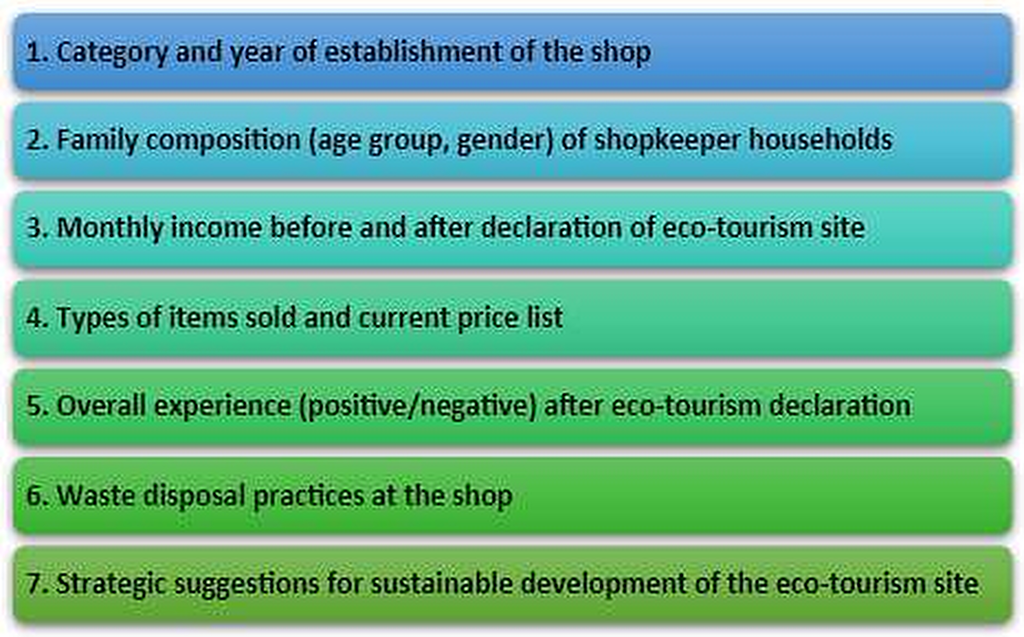
The shopkeeper questionnaire was designed to assess:
- Category and year of establishment of the shop
- Family composition (age group, gender) of shopkeeper households
- Monthly income before and after declaration of eco-tourism site
- Types of items sold and current price list
- Overall experience (positive/negative) after eco-tourism declaration
- Waste disposal practices at the shop
- Strategic suggestions for sustainable development of the eco-tourism site


Annexure I – Questionnaire for Tourists
The tourist questionnaire captured data on visitor demographics, travel behavior, and expenditure patterns:
Demographics
- Name, age, gender
- Place of origin
- Occupation and income level
Travel Behavior
- Mode of transport
- Duration of visit
- Purpose of visit
Expenditure
- Transport costs
- Food and lodging
- Entry fees and misc. expenses
Satisfaction
- Overall experience
- Suggestions for improvement
- Likelihood of revisiting
ANNEXURE III – PHOTOGRAPHS DURING SURVEY



Acknowledgement
The author sincerely acknowledges the field investigators: Chiranjib Malla, Sradha Pariyar, Priya Gurung, and Kuldeep Kumar Parewa (Junior Assistant, IIFM Kurseong office).
Shri Samir Gajamer, IFS (Chief Conservator of Forests, Hill Circle); Shri Sambarta Sadhu (Forest Range Officer, Kurseong Division – whose idea it was to start an eco-tourism spot at Dowhill); Dablu Gurung (Forest Guard, Kurseong); Range Officer Manoj Chettri; Field Guards; Tourists; Respondents; Villagers; and Shopkeepers for giving their valuable time in the study area of Dowhill.
Moreover, continuous discussions and invisible support from: Prof. Binayak Sundas (Director, Centre for Himalayan Studies) and Prof. Samar Kumar Biswas (Prof. and Head, Department of Social Anthropology) for their insights and developing strategies for Sustainable Natural Resource Management for Future Generations.
REFERENCES:
- Badan B.S. (1998), Tourism in India, Commonwealth Publisher New Delhi.
- Bansal S.P., Kulshreshtha S. & Gautam P. eds (2011), Tourism for Development: A Managerial Approach, Kanishka Publishers, New Delhi.
- Bhattacharya A.K. (2005), Ecotourism and Livelihoods: Capacity Building for local Authorities, Concept Publishing, New Delhi.
- Biswas, Somnath (2012), Problems and Prospects of Eco-tourism in India, Special reference to ‘Bhitarkanika’, IJHSS Vol.1, Issue 1, Aug 2012.
- Boo, E. (1990), Ecotourism: the Potentials and Pitfalls, Vol. 1, World Wildlife Fund, Washington.
- Buckley, R.C. (2002a), Public and Private Partnerships between Tourism and Protected Areas, Journal of Tourism Studies 13.
- Buckley, R.C. (2003a), Case Studies in Ecotourism, CAB International, Wallingford, U.K.
- Buckly Ralf, (2009), Ecotourism: Principles of practices, CAB International, USA.
- Butcher, Jim. (2007), Ecotourism NGOs and Development, Routledge, USA.
- Cater, C. and Cater, E. (2007), Marine Ecotourism: Between the Devil and Deep Blue Sea, CAB International, UK.
- W.T.O. (1993), Sustainable tourism Development: Guide for local planners. World Tourism Organization.
- W.T.O. (1998), Guide for local authorities on developing sustainable tourism planners. World Tourism Organization.
- Udgata, HarshaBardhan (2012), Eco-Tourism Destinations of Odisha, Odisha Review November 2012 pp. 45–49.
- Bharara L.P. (1978), Socio-Economic Consequences of Drought in an Arid Tract – International Symposium on Arid Zone Research & Development, CAZRI, Jodhpur.
- Bharara L.P. (1992), Perception of Drought and Desertification by Indian Desert Dwellers – In Noor Mohammad (ed) Human Perception and Technological Change in Agriculture, Vol. vi, Concept Publishers, New Delhi.
- Bowden, M.J. (1976), The Great American Desert in the American Mind – In Lowenthal and Bowden, eds Geographies of the Mind, Oxford University Press, New York.
- Brindha V., Ray K.A. and Rajadurai M. (2005), Tourist Arrivals and Bio-diversity Conservation of Kodaikanal. The Green Portal Vol.2, No. 1, p. 82.
- Buckley, R.C. (2002), Public and Private Partnerships between Tourism and Protected Areas, Journal of Tourism Studies 13, 26–38.
- Singh, S. and Singh, T.V. (1999), Tourism Developments in Critical Environments, Cognizant, New York.


Authors Are:
DFO, Kurseong Forest Division, Kurseong Faculty
Environment and Developmental Economics