




FOREST ECOSYSTEM: FOREST TYPES OF INDIA
Dr. Sharda1 R. Gupta2
Introduction:
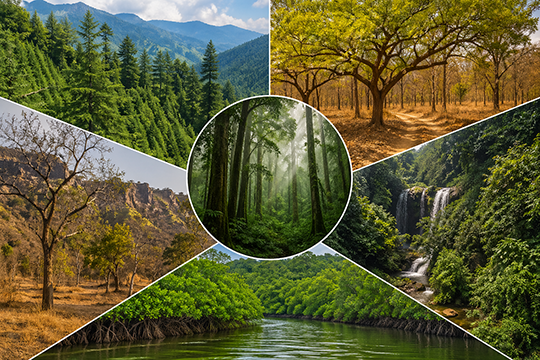
Forests in India are very diverse in their composition with a long evolutionary and geological history, occurring under diverse climatic and edaphic conditions. The forests represent a very unique assemblage of both Indo-Malayan and Australian species indicating the geological and paleo-botanical value of these forests. The forest types of India were classified for the first time in 1936 by Sir HG Champion and compiled his monumental work ‘Preliminary Survey of Forest Type of India and Burma’ (Champion 1936). Champion and Seth classified India’s forests into 16 major types and about 221 sub-type groups; published ‘A Revised Survey of the Forest type of India’ in 1968. The detailed classification of forest types in India is based on climate, physiognomy, species composition, phenology, topography, soil factors, altitude, aspect, and biotic factors (Champion and Seth, 1968). The forests have been classified into six “major groups”, ranging from tropical to alpine These major groups have been further classified into 16 sub-groups on the basis of temperature and moisture regimes, and more than 200’group categories'(see, Singh and Chaturvedi, 2017).
Major Forest Types:
At the beginning of the 20th century about 30% of land in India was covered with forests. But by the year 2015 the forest cover has been reduced to 21.34%. In 2015, of the existing forests, about 2.61% are very dense forests (canopy cover 70% or more), 9.59% moderately dense forests (canopy cover 40% or more but less than 70%), 9.14% open forests (canopy cover 10% or more but less than 40%), and 1.26% scrub forests (canopy cover less than 10%) (FSI 2015). Mizoram, with 88.93% of forest cover has the highest forest cover in percentage terms, followed by Lakshadweep (84.56%). Madhya Pradesh is having largest total forest cover (77, 462 km2) in India, followed by Arunachal Pradesh (67,248 km2) and Chhattisgarh (55,586 km2) (FSI 2015).
Table 25. 1. The major forest types of India (based on Champion and Seth, 1968)
Major Forest Groups Forest Groups:
1: Moist Tropical forests Group1: Tropical Wet Evergreen Forests Group
2: Tropical Semi-evergreen Forests Group
3: Tropical Moist Deciduous Forests Group
4: Littoral and Swamp Forests II. Dry Tropical forests Group
5: Tropical dry deciduous forest Group
6: Tropical thorn forests Group
7: Tropical dry evergreen forests III. Montane Subtropical Forests Group
8: Subtropical broad-leaved hill forests Group
9: Subtropical pine forest Group
10: Subtropical dry evergreen forests IV. Montane Temperate Forests Group
11: Montane wet temperate forests Group
12: Himalayan moist temperate forests Group
13: Himalayan dry temperate forests V. Sub alpine forests Group
14 Sub alpine forests VI. Alpine Forests Group
15: Moist-Alpine Scrub Group
16: Dry-Alpine Scrub
25.2 1. MOIST TROPICAL FORESTS
Southern wet tropical evergreen forests:
The southern tropical wet evergreen forests occur in the Western Ghats, and Andaman and Nicobar; the most widely distributed genera are Dipterocarpus and Hopea. In the Western Ghats, rainfall ranges from 1500 to 5000mm; altitude varies from 250 to 1200m.
i. The evergreen forests of the Western Ghats have a very high percentage of species endemic to the region.
ii. The Western Ghats are considered as one of the biodiversity hot spots of the world (Myers et al., 2000). The Nilgiri Biosphere Reserve in the Western Ghats was the first biosphere reserve in India established in the year 1986.
iii. The evergreen forests of Wayanad, Kerala are characterized by high proportion of Mesua ferrea, Palaquium ellipticum, Cullenia sp., and Calophyllum elatum.
Northern wet tropical evergreen forests:
The northern wet tropical forests occur in upper Assam, northern Bengal and Arunachal Pradesh, dominated by trees of the family Dipterocarpaceae. Bamboos are usually present. Climbers are abundant, palms and canes generally present; abundance of epiphytes, ground cover is mainly composed of evergreen shrubs. Some salient features of these forests are:
i. The upper Assam valley tropical wet evergreen forests- Dipterocarpus, Mesua ferrea, Dysoxylum spp, Echinocarpus, and Canarium spp.
ii. The giant Dipterocarpus macrocarpus (Hollong) and Shorea assamica in Assam valley occur in patches, attain high girths up to seven meter and height up to 50m.
iii. The Cachar Tropical Evergreen Forest occur in lower hills and hill slopes of Cachar hills, and the Khasi and Jaintia hills around the Surma valley. The forest is Mesua Dipterocarpus-Palaquium formation.
The northern and southern wet tropical evergreen forests are described in Table 25.2 2.
2. Tropical Semi-Evergreen Forest:
These forests occur in areas adjoining tropical wet evergreen, and form a transition between the evergreen and moist deciduous forests. Lower canopy is evergreen, whereas canopy species are deciduous for short periods during the dry seasons. Tropical Semi-evergreen Forest type comprises 13.79% of the Indian forest types. These are dense, multi-strata, 24-36m in height.
- Rainfall ranges from 1500-2500mm per year.
- The canopies are not continuous and species richness lower as compared to evergreen forests.
- Buttressed stems occur in the case of both evergreen and deciduous trees (e.g. Elaeocarpus spp, and Salmalia sp).
- Bamboos, canes, ferns, climbers are common. Epiphytes are abundant including many ferns and orchids.
- These are not climate climax formations, but occur as edaphic sub climax on shallow poor soils.
- The northern and southern tropical Semi-evergreen forests are described in Table 25.3.2.
Southern Tropical Semi-evergreen Forest:
Distributed in Western Ghats where rainfall gradient is steep, north of Bombay, near Goa, and South of Cochin; Andaman (in the main valley), Tiruneveli (eastern slopes of the southern Western Ghats).
i. The forests are composed of both evergreen and deciduous species in the top storey.
ii. Upper canopy composed of Xylia and Terminalia, Dipterocarpus, Balanocarpus, Hopea spp.
iii. Middle canopy trees belong to family Myrtaceae, Lauraceae
iv. Ground-floor is composed of evergreen shrubs belonging to Rubiaceae and Acanthaceae.
Northern Tropical Semi-evergreen Forest:
These types of forests occur in moderate to heavy rainfall areas of Assam, West Bengal, and Odisha, includes the following types:
i. Assam valley and alluvial plains Semievergreen Forest
ii. Eastern submontane Semi-evergreen Forest: Schima-Bauhinia association
iii. Sub-Himalyan light alluvial Semi-evergreen Forest: Terminalia- Phoebe association
iv. Cachahar semi-evergreen forest – Assam: mixed semi-deciduous type; Manipur: Tectona, Dipterocarpus hylium.
v. Odisha tropical semi evergreen forest: occur on the Odisha hills at about 800m and in lower permanently moist valleys. Composed of Artocarpus, Mesua ferrea, Terminalia spp, Michelia sp, Phoebe spp, and Litsea sp.
Group 3: Tropical Moist Deciduous Forest:
These forests are common in areas where rainfall is 1000 to 2000 mm with a dry season of three to four months. Dominant trees are deciduous, lower storey trees are usually evergreen. The trees shed their leaves in winter months, again become flushed in March-April. These forests comprise 19.73% of India’s forest types (FSI 2011). These forests are widely distributed covering both in southern and northern states including Tamil Nadu, Arunachal Pradesh, Assam, Meghalaya, Mizoram, Bihar, West Bengal, Odisha, and Uttarakhand. These forests are usually 2 to 3 strata with a much lower number of species as compared with the tropical evergreen and semi evergreen forests. The canopy trees are light demanding, middle ones are shade tolerant species of shrubs and young trees, and on ground floor are present herbs and saplings. Climbers are abundant. The northern and southern tropical moist deciduous forests are described in Table 25.4
Southern Moist Deciduous Forests:
These forests are distributed in Maharashtra, Mysore, Tamil Nadu, and Arunachal Pradesh. Tectona grandis is dominant in the southern Moist Deciduous Forests with the following variations:
i. Very moist teak forests occur in Kerala and Tamil Nadu in high rainfall areas over 2500mm on deep alluvial soils.
ii. Moist-teak bearing forests, southern moist mixed deciduous forest and southern secondary moist mixed Deciduous Forest.
iii. Moist teak forests are associated with Terminalia spp, Pterocarpus spp, Adina, and Dalbergia latifolia. Bamboos are quite common. Bambusa arundinacea and Dendrocalamus strictus are the most common bamboo.
Northern Moist Deciduous Forests: The northern moist deciduous Forests are dominated by Shorea robusta with the following variations:
i. Very moist sal-bearing forests occur in Sikkim, West Bengal, the Garo, Khasi hills, and Jaintia hills, Assam and Meghalaya. These forests are composed of Shorea robusta, Schima wallichii, Stereospermum personatum.
ii. Moist Siwalik sal forests occur on Nahan Sandstones, whereas sandy alluvium soil with dry subsoil.
iii. Moist peninsular sal forests also occur in Madhya Pradesh, and Odisha; common associates being Pterocarpus marsupium, Anogeissus latifolia, Syzygium cumini, Phoenix acaulis etc.
iv. Moist mixed deciduous forests occur in Siwalik Hills of Uttarakhand. In eastern Himalaya in Bengal and Assam.
Group 4: Littoral and Swamp Forests:
These forests consist of evergreen species of varying densities and height, usually associated with mesic habitats. These forests are mostly in their developmental stage and are seral in nature.
i. The littoral forests occur along the coast in the Andaman and Nicobar, Andhra Pradesh, Odisha, and Tamil Nadu. The most characteristic species is tall and evergreen Casuarina on 10 Environmental Sciences Ecosystem Structures & Functions Forest ecosystem: Forest Types of India sandy beaches and dunes along the sea face. In Andaman, the forests are dominated by Manilkara littoralis.
ii. The tidal and swamp forests (mangrove scrub) are dominated by several evergreen and semievergreen species in deltas of the Ganga and the Brahmaputra rivers.
iii. Mangroves are found along the east and west coasts of India, the Andaman and Nicobar Islands, the Gulf of Kachchh and Khambat (Gujarat). Sundarban (40% in West Bengal) is the largest mangrove in the world. Mangrove forests are generally dominated by trees of the genera – Rhizophora, Avicennia, Sonneratia, Bruguiera, and Ceriops. Some genera like Heritiera and Xylocarpus. On the drier areas within the salt water mangrove scrub/forest are found palm swamp.
iv. Tropical fresh water swamps such as Myristica swamp forest occur in Travancore, Kerala, contain species such as Myristica spp., Lagerstroemia speciosa.
v. The species like Baringtonia spp, and Syzygium cumini, are found in swamps forests of UP and West Bengal
25.2.2. II. DRY TROPICAL FORESTS:
Group 5: Tropical Dry Deciduous Forests:
These are largest forest type of India covering about 38.2% of the forest area of the country. Tropical dry forests occur in climates exhibiting a marked seasonality in rainfall and prolonged drought period over the annual cycle. These forests consist of trees less than 25m high, with a light demanding canopy consisting of deciduous trees. These forests occur from Kanyakumari to the foothills of the Himalaya in low rainfall areas of 800 to 1200mm; large areas of these forests are suitable habitats for wildlife. Dry teak and dry sal communities predominate in the southern and northern regions, respectively. In some areas a mixture of trees like Anogeissus pendula, Boswellia serrata, Hardwickia binata, Acacia nilotica, Madhuca indica, and Butea monosperma occupy the area. Acacia catechu and Dalbergia sissoo are conspicuously present on newly formed soils. The northern and southern tropical Dry Deciduous forests are described in Table 25.5.
Southern Tropical Dry Deciduous Forest:
Occupy whole of peninsular India (except coastal Karnataka). These forests are distributed in Maharashtra, Karnataka, Andhra Pradesh, MP, and Tamil Nadu. The main climax types include:
i. Dry Teak bearing forest: Tectona grandis, Boswellia serrata, Anogeissus latifolia, Sterculia sp., and Acacia catechu.
ii. Dry red sanders bearing forest: Pterocarpus santalinus predominates forming pure associations over extensive areas, and teak is absent..
iii. Southern dry mixed deciduous forest: Boswellia serrata is conspicuous, distributed throughout peninsular India; common trees are Anogeissus latifolia, Terminalia tomentosa, and Hardwickia binata.
iv. Dry mixed forest with Tectona grandis
v. Sandal (Santalum album) bearing scrub forest.
Northern Tropical Dry Deciduous Forest:
Occur in Bihar, Bengal, Odisha, Gujarat, UP, Haryana. Shorea robusta is of low quality in these forests. These are of following types:
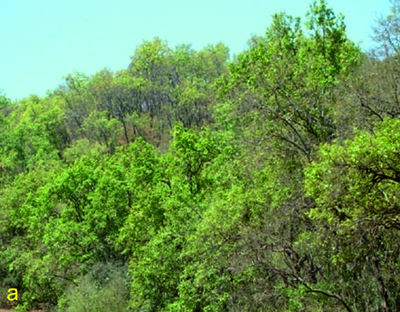
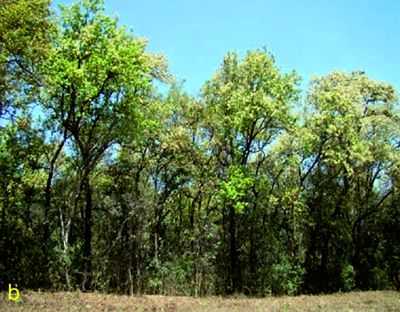
i. Dry Siwalik sal forest are dominated by Shorea robusta, Anogeissus sp., Buchnania lanzan, whereas dry plains sal forests are composed of Shorea robusta, Terminalia tomentosa, Madhuca india, and Diaspyros sp. In Kalesar reserve forest in Haryana, the forests are mainly composed of dry Siwalik Shorea robusta forest, dry plains Shorea robusta forest (Fig.1), northern dry mixed deciduous forests, and the dry tropical riverine forests.
ii. Dry peninsular sal forest: Occur in regions of Bihar, MP (Pachmarhi plateau), Odisha, UP, west Bengal, Chhattisgarh (Amarkantak); Shorea robusta mixed with Boswellia serrata.
iii. Northern Dry mixed Deciduous Forest: Main trees are Anogeissus latifolia, Boswellia serrata.
iv. The dry deciduous scrub is distributed throughout the dry deciduous forest zone of India.
v. The edaphic climax types in dry deciduous forests occur in some regions of Rajasthan.
Group 6: Tropical Thorn Forests:
These forests are found in low rainfall areas (200 to 800mm) of northern India, peninsular India and central India. Moisture availability is limiting for plant growth. The trees experience prolonged dry periods. The tree height ranges from six to nine meters.
Southern Tropical Thorn Forests:
Occur in Maharashtra, Tamil Nadu and AP. In south India, important species are Acacia chundra, Acacia planifrons and Acacia catechu.
Northern Tropical Thorn Forests:
Occur in semiarid regions of Rajasthan, Punjab, Haryana, northern Gujarat, MP, UP , and Delhi.
1. These forests are open, consisting of short trees, generally belonging to thorny tree species. The desert thorn type consist of Acacia senegal, Prosopis spicigera, Prosopis cineraria, Acacia leucophloea, Acacia nilotica, Ziziphus spp, and Salvadora spp. Acacia tortilis and Prosopis chilensis have been widely planted in this region.
2. The desert dune scrub are very open, irregular formations of stunted trees and bushes, these are sparse and thorny. The main species are Acacia senegal, Prosopis spicigera, Acacia Arabica, Tamarix aphylla, Salvadora oleoides.
Group 7: Tropical Dry Evergreen Forests:
The forests are restricted in distribution to Karnataka coast, also reported from the east coast in AP. These are low growing forests; trees are of 9-12 m height, and form a complete canopy. Most conspicuous trees are Manilkara hexandra, Memecylon edule along with Diaspyros, Eugenia, Chloroxylon, Albizzia amara. There is a high diversity of trees, shrubs and herbs in these forests.
25.2.3. (III) MONTANE SUBTROPICAL FORESTS:
Group 8: Subtropical Broad Leaved Hill Forests:
These forests are of the following types:
i. Southern Subtropical Broad Leaved Hill Forests In south India, these forests are found in the hill slopes and tops at about 1000 to 1700m height in Nilgiri, Palani, Tirunelveli, and Mercara hills. Main trees are Calophyllum elatum, Eugenia spp., Dalbergia latifolia, Anogeissus latifolia, Emblica officinalis, Olea dioca, and Phoenix humilis.
ii. Central Indian Subtropical Hill Forests Hill top forests occur above 1200m in Madhya Pradesh (Pachmarhi), Bihar, Odisha. In Pachmarhi hills, Manilkara hexandra, Mangifera, Syzygium cumini are conspicuous trees.
iii. Northern Subtropical Broad Leaved Hill Forests Occur in Arunachal Pradesh, Manipur, Mizoram, Meghalaya, Nagaland Sikkim, and west Bengal represented by east Himalayan subtropical wet hill forest, Altitude 1000-to 2000m, Occur in Khasi, Jainti and adjacent hills, dense evergreen forests, rarely exceeding 20m height. Important tree species are Quercus, Castanopsis, Alnus, Prunus, Betula and Schima. There is heavy growth of epiphytic mosses, ferns and phanerogams. Subtropical broad leaved hill forest dominated by Quercus serrata, Eugenia praecox, Schima wallichii, Rhus succidanea located located at Imphal, Manipur is shown in Fig.25.3.
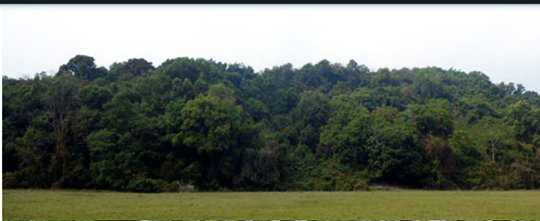
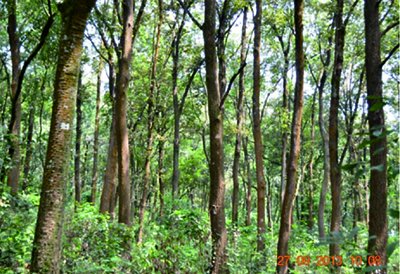
(Photo: Dr Amrabati Thokchom)
Group 9: Sub-Tropical Pine Forests
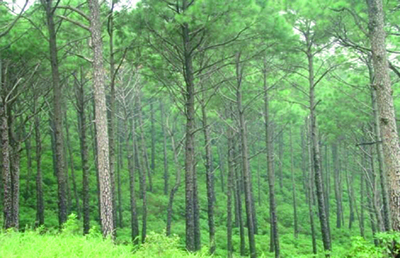
Sub-tropical chir pine (Pinus roxburghii) forests occur throughout the central and western Himalaya between 1000 to 1800m; distributed in Haryana, Himachal Pradesh, Jammu and Kashmir, Punjab and Uttrakhand. Pinus roxburghii along with broad leaved species is the main characteristics of these forests. Climbers and bamboos are absent. A view of Sub-tropical chir pine (Pinus roxburghii) forest in Morni hills in north-east Haryana is shown in Fig. 25.4.
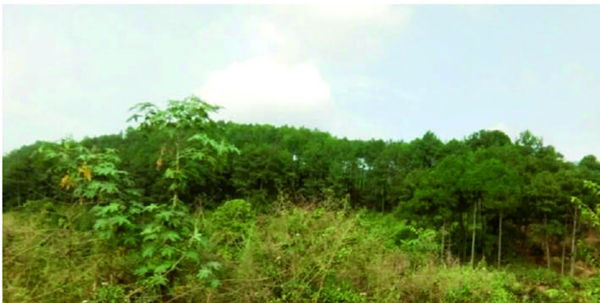
The forests of Pinus keysia along with Schima wallichii occur in Khasi and Naga Hills, and Manipur hills, in eastern Himalaya (Fig.25.5). Pinus kesiya is often a pioneer in deforested secondary vegetation, especially if fire has been a factor in the disturbance.
Group 10: Sub-Tropical Dry Evergreen Forests
These forests are distributed in Bhabar tract, Shiwalik hills, and the foothills of western Himalaya. In Punjab, Uttrakhand, and Himachal Pradesh, Olea cuspidata is found on alluvial ground of wider valleys. In Jammu and Kashmir, the dominant species of these scrub forests are Olea cuspidate, Acacia modesta, and Dodonaea viscosa
25.2.4 IV. MΟΝΤΑΝΕ TEMPERATE FORESTS
Group 11: Montane Wet Temperate Forest
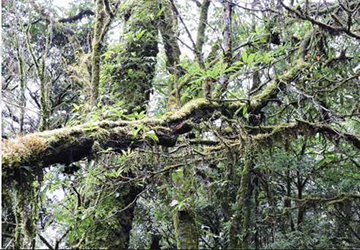
The southern Montane wet temperate forests are closed evergreen forest, trees are mostly short boled (not exceeding 6m), and highly branched. The branches are clothed with mosses, ferns and other epiphytes, woody climbers are common. The northern Montane wet temperate forests are a characteristic feature of the eastern Himalaya and are found between 1800 m and 3000 m elevation in high rainfall areas (>2000mm rainfall); The northern and southern Montane wet temperate forests of India are described in
Table25.6. Table25.6. The northern and southern Montane wet temperate forests of India.
The southern Montane wet temperate forests
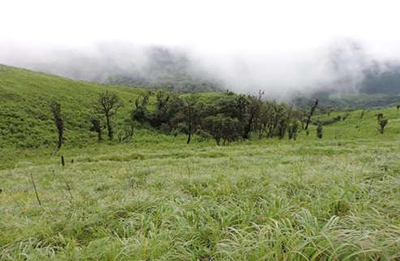
- These forests are found in patches (Sholas) in the more sheltered sites on rolling grasslands. Occur in high hills of Tamil Nadu and Kerala on the, Anamalai, Palni and Tirunelveli hills from about 1,500 m upwards.
- In the southern Indian hills, important species belong to Syzygium spp, Eurya, Michelia nilagirica, and Ternstroemia. Rhododendron nilagiricum is important components.
- The forests are luxuriant with dense undergrowth, epiphytes, and woody climbers. Southern Indian wet grasslands occur over large areas on the rolling downs.
Northern Montane wet temperate forests
- These forests occur in Bengal, Sikkim, Assam, Manipur are closed evergreen high forests of large girth class, medium height (~25m), oak forests with Quercus lamellosa, Castanopsis, Machilus, and Rhododendron. Acer, Prunus, Ulmus, and other deciduous genera are present.
- Northern Montane Wet temperate forest at the Ukhrul district of Manipur, dominated by Rhododendron arboreum and Quercus sp. located at an altitude of 1900m msl is shown in Fig.25.6.
- In higher hills along the Assam/Burma border, these forests occur at an altitude of 1800-2500m and composed of Alnus nepalensis, Betula alnoides, Acer, Prunus and Pyrus.
Group 12: Himalayan Moist Temperate Forests
These forests extend the whole length of the Himalayan region between the sub-tropical pine forest and sub-alpine forests. Altitude ranges from 1500m to 3300m. These are concentrated in the central and western Himalaya, except in areas where rainfall is below 1000 mm. Distributed in Kashmir, Himachal Pradesh, Punjab, Uttrakhand, Darjeeling district of west Bengal, Assam, and Sikkim.
i. Several species of oak predominate in the temperate forests including Quercus leucotrichophora, Quercus. Floribunda, Quercus incana, Quercus semecarpifolia, Quercus dilatata, Q. larginosa. All oak species in Himalayan region are evergreen showing leaf fall in summer, but are never leafless. There are four strata, 25-30m height, tree canopy is dense, herbaceous layer not well developed, grasses generally lacking, and rich in epiphytes. A view of temperate oak forest at Munsiyari Pithoragarh, Uttarakhand in Kumaun Himalaya is shown in Fig.25.7.
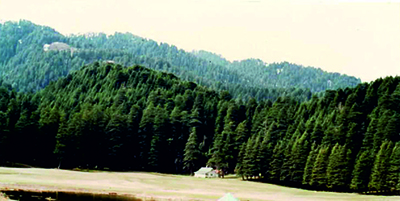
ii. Most Cedrus deodara forests form pure stands, canopy is fairly complete, boles are straight and tall (30-40m), There are scattered oaks and Rhododendron under the conifers. The evergreen Cedrus deodara forest surrounding the Khajjiar lake located at 1920 m above mean sea level in Khajjair, Chamba district, Himachal Pradesh in western Himalaya is shown in Fig.25.8.
iii. As the altitude increases, the upper form consisting of Abies pindrow, Picea smithiana, and Quercus semecarpifolia becomes dominant.
iv. The eastern Himalayan hills are occupied by Quercus. lineata, Quercus lamellosa, Quercus pachyphylla, Rhododendron spp., Tsuga dumosa, Picea spinulosa and Abies densa.
v. Cupressus torulosa is a conspicuous species found on limestone rocks from Chamba (Himachal Pradesh) to the Aka hills at 1800 to 2800 m.
Group 13: Himalayan Dry Temperate Forests
Conifers predominate, distributed on 1700 to 3000m altitude, in the inner ranges of Himalaya, rainfall usually less than 1000mm mostly received as snow in winter months. Distributed in Kashmir, Ladhakh, Lahaul, Chamba, inner Garhwal, and Sikkim.
- Coniferous forests are tall (30-35m) and have evergreen canopy.
- These forests consist of both coniferous and broad-leaved species. In the western Himalaya, the characteristic species are Pinus gerardiana, Cedrus deodara and Juniperus. At higher elevation, Abies pindrow, and Pinus wallichiana are found.
- In the eastern Himalaya, the common species are from Abies and Picea. In higher hills, Juniperus wallichiana is common.
- Locally, between 2500 and 4000 m elevation, a few other species like Larix griffithiana, Populus eupheretica, Salix spp., Hippophoe spp. and Myricaria spp. also occur.
25.2.5. (V) SUB-ALPINE FORESTS
Group 14: Sub-Alpine Forests
The subalpine forests occur throughout the Himalaya above 3000 m elevation up to the tree limit., rainfall 83-600mm. The forests are mainly evergreen, Rhododendron is common constituent. Tall trees are conifers; Betula utilis is present as the largest deciduous tree and associated with genera like Quercus semecarpifolia, Sorbus, and Rhododendron sp.
Western Himalaya sub-alpine forests reported from Jammu and Kashmir, Himachal Pradesh, and Uttrakhand. In the western Himalaya, there are two types of forests (i) Abies spectabilis and Betula utilis, (ii) west Himalayan sub-alpine birch/fir forest.
In the eastern Himalaya, these forests occur above 3000m. These forests are distributed in Arunachal Pradesh, Sikkim, and west Bengal. There is predominance of Abies densa and Betula utilis, and Rhododendron spp. These are climax formations, self generating with marked resilience.
25.2.6. (VI) ALPINE FORESTS
Group 15: Moist- Alpine Scrub
Moist Alpine Scrub occurs throughout Himalaya, above timber line to 5,500m altitude, composed entirely of species of Rhododendron with some birch (Betula) and other deciduous trees. The tree trunks are short and highly branched, moss and ferns cover the ground. A thick layer of humus is present and soil is generally wet.
- In Kumaun, Uttrakhand, Betula utilis and Rhododendron campanulatum scrub forest occur. Rhododendron- Lonicera association occurs in Uttrakhand, in inner Himalaya.
- In eastern Himalaya, dense Rhododendron thickets occur at 3350-4600m altitude. These forests are reported from Arunachal Pradesh, Sikkim and west Bengal.
Group 16: Dry- Alpine Scrub
It is a xerophytic formation, having predominance of dwarf shrubs; rainfall <370mm per year. Characteristic plants are Juniperus wallichiana, Lonicera spp, Potentilla spp. Vegetation along the streams is composed of Salix, Myricaria, and Hippophae rhamnoides. These scrub forests are distributed in Jammu and Kashmir, Himachal Pradesh, Uttrakhand, and Arunachal Pradesh. In eastern Himalaya, Juniperus recurva and Juniperus wallichiana occur at an altitude ranging from 3000 to 4600m.
25.3. New Classification of Forest Types of India
Recently, the new classification of forest types has been proposed reflecting the present ecological, climatic, bio-geographic and edaphic influences on the vegetation composition and stand formation 24 Environmental Sciences Ecosystem Structures & Functions Forest ecosystem: Forest Types of India
(see ICFRE 2013; Bahuguna et al. 2016). India’s forest types are very diverse in their compositions with a long evolutionary and geological history, occurring under many climatic and edaphic conditions. They have been undergoing significant changes in the composition of forests since the forest types were revised by Champion and Seth (1968). The revised classification of forests has been based on the field survey covering more than 200 forest types and subtypes representing very diverse climatic and edaphic conditions throughout the country. Data were collected from the field surveys in terms of forest types, basal area, importance value index, stem density and diversity indexes including similarity indexes. Impact of climate change on the vegetation has been critically examined. The new classification of forest types reflects the present ecological, climatic, bio-geographic and edaphic influences on the vegetation composition and stand formation. In the proposed new classification, 10 major groups and 48 sub-groups have been were identified (ICFRE 2013; Bahuguna et al. 2016). The study has reported many changes occurring at species and forest subtypes levels. There are some positive and negative changes in different forest types. Some trends in the new classification of forest types are summarized as follows:
1. The species level changes were observed largely in Shorea robusta (Sal), Tectona grandis (Teak) and Bamboo forests with regard to their distribution and species density. The study has revealed that teak is found absent from very moist and moist teak sub-type, and occurrence of many moist deciduous and semi-evergreen species.
2. In central India, the decline of Shorea robusta (Sal) and occurrence of dry deciduous species, fragmentation and changes in the species composition due to anthropogenic and climate changes.
3. The vegetation composition, particularly on the alpine flora is experiencing the effect of climate change.
4. There are changes in species composition of Shola forests and evergreen forests.
5. The forests in Andhra Pradesh, Karnataka and Gujarat have shown positive changes in the forest composition and density.
6. Analysis based on national level data showed change in temperature and rainfall patterns reveal that many forests are moving towards drier conditions, particularly the temperate forests. There are changes in the pattern of distributions of Oaks and Conifers.
7. The blue pine (Pinus wallichiana) found in the higher elevations up to 1700 m is now found in still higher elevations up to 2700 m showing a the shift in the tree lines towards higher elevations.
25.4. Summary
i. Champion and Seth (1968) gave the detailed classification of forest types in India based on climate, physiognomy, species composition, phenology, topography, soil factors, altitude, aspect, and biotic factors.
ii. The forests have been classified into six major forest types and 16 major groups on the basis of temperature and moisture regimes.
iii. The tropical wet evergreen forests are dense and show 30-45m tall canopy structure with four or five strata, generally found in the Western Ghats, north-eastern India and Andaman and Nicobar having rainfall in the range of 2000 to > 3000 mm.
iv. The tropical semi-evergreen forests occur in areas adjoining tropical wet evergreen, and form a transition between evergreen and moist deciduous forests.
v. Tropical Moist Deciduous Forests are common in areas where rainfall is 1000 to 2000 mm with a dry season of three to four months, widely distributed covering both southern and northern states.
vi. Mangroves are found along the east and west coasts of India, the Andaman and Nicobar Islands. Sundarban (is the largest mangrove in the world).
vii. Tropical Dry Deciduous Forests are largest forest type of India covering about 40% of the forest area of the country, dry teak (Tectona grandis)and dry sal (Shorea robusta) forests predominate in the southern and northern regions of India, respectively.
viii. Tropical thorn forests are found in low rainfall areas of northern India, peninsular India and central India, moisture availability is limiting for plant growth, the trees experience prolonged dry periods.
ix. Subtropical Broad Leaved Hill Forests occur in the hill slopes and tops at about 1000 to 1700m height in south India and northern India.
x. Sub-tropical chir pine (Pinus roxburghii) forests occur throughout the central and western Himalaya between 1000 to 1800m. The forests of Pinus keysia occur in Khasi and Naga Hills and Manipur hills in eastern Himalaya..
xi. The southern Montane wet temperate forests Occur in high hills of Tamil Nadu and Kerala on the, Anamalai, Palni and Tiruneveli hills from about 1,500 m upwards. Tiruneveli
xii. Northern Montane wet temperate forests are a characteristic feature of the eastern Himalaya and are found between 1800 m and 3000 m elevation in high rainfall areas (>2000mm rainfall).
xiii. Himalayan Moist Temperate Forests are distributed in northern India at altitude ranging from 1500m to 3300m. Several species of oak predominate in the temperate forests
xiv. The Himalayan Dry Temperate Forest: Conifers predominate, 1700 to 3000m altitude, in the inner ranges of Himalaya, rainfall usually less than 1000mm.
xv. Sub-Alpine Forests occur throughout the Himalaya above 3000 m elevation up to the tree limit.
xvi. The new classification of forest types has been proposed reflecting the present ecological, climatic, bio-geographic and edaphic influences on the vegetation composition and stand formation.
References
- Bahuguna, V.K.. Swaminath, M.H, Tripathi, S., Singh, T.P., Rawat V.R.S., and Rawat, R.S.. (2016). Revisiting forest types of India. International Forestry Review 18:135-145.
- Champion, H.G. (1936). A preliminary survey of the forest types of India and Burma. Indian Forest Records (n.s.) Silva. X (1).
- Champion, H.G. and Seth, S.K. (1968). A Revised Survey of the Forest Types of India. The Manager of Publications, Delhi-6.
- FSI (2011). Atlas Forest Types of India. Forest Survey of India, Ministry of Environment of Forests, Dehradun.
- FSI (2015). India State of Forest Report. Forest Survey of India, Ministry of Environment of Forests, Dehradun.
- ICFRE 2013. Forest Types of India. Revisited. 2013. Indian Council of Forestry Research and Education, Dehradun.
- Myers, N., Mittermeier, R. A., Mittermeier, C. G., da Fonseca, G.A.B. and Kent, J. (2000). Biodiversity hotspots for conservation priorities. Nature 403: 853-856.
- Pascal, JP,, Ramesh, BR and Dario DE Franceschi. (2004). Wet evergreen forest types of the southern Western Ghats, India. Tropical Ecology 45: 281-292.
- Singh, JS and Chaturvedi, R.K. (2017). Diversity of Ecosystem Types in India: A Review. Proceedings of the Indian National Science Academy 83: 569-594
Author:
Former Professor, Botany Department,
Kurukshetra University, Kurukshetra
Courtesy: