
– Abhijit Sharma
In a Times of India interview ahead of the first International Big Cat Alliance summit, Hon. Minister Shri Bhupender Yadav makes the case for coexistence — and the livelihoods of local communities will decide whether it lasts
Ahead of the first International Big Cat Alliance (IBCA) summit, to be held in New Delhi on June 1–2, the Union Environment Minister, Hon. Minister Shri Bhupender Yadav, has set out India’s vision for big cat conservation in an interview with The Times of India. His central message is that the country’s success cannot be read off a population chart alone. India’s conservation approach, he told the newspaper, is “not limited to increasing big cat numbers alone”.
That single sentence marks a significant shift in emphasis. For years, conservation milestones in India were announced largely as headcounts — of tigers, of lions, of leopards. The Hon. Minister argues the real work now runs deeper. Equal weight, he says, is being placed on habitat expansion, corridor connectivity and landscape-level conservation. The country’s approach, in his words, has “gone far beyond a mere ‘numbers narrative’”, with the broader focus falling on healthy ecosystems, genetic diversity, and the “long-term coexistence of people and wildlife”.
Over the past decade, the Hon. Minister notes, India has expanded its protected areas, tiger reserves, eco-sensitive zones and wildlife corridors, while strengthening habitat restoration and prey-base management. The aim is a connected mosaic of landscapes rather than isolated islands of forest — and the results are visible in how far the animals now roam.
WHEN THE WILD MOVES INTO THE NEIGHBOURHOOD
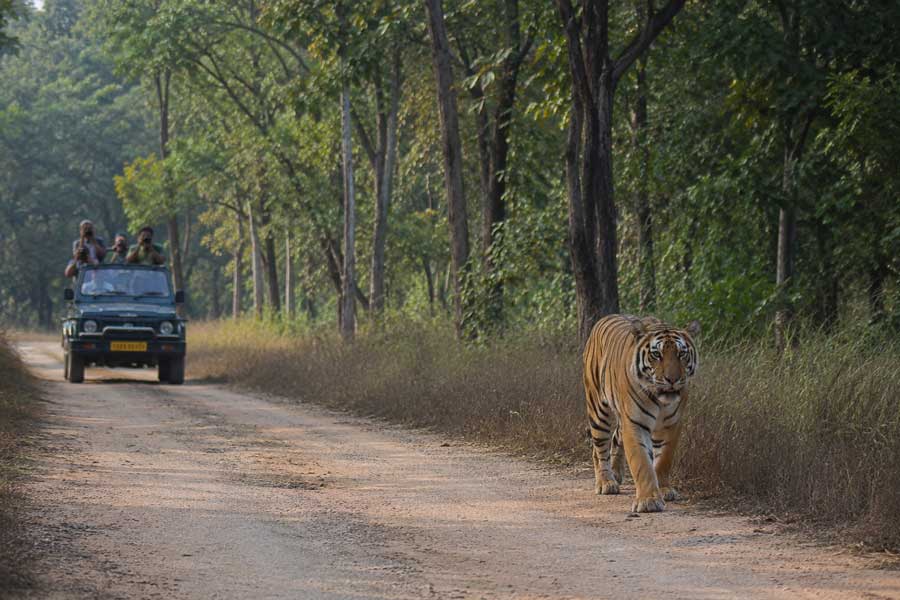
Nothing illustrates the stakes better than a figure the Hon. Minister highlights: nearly one-third of India’s tigers now live outside core tiger reserves. He frames this as evidence of improved landscape connectivity and the dispersal of big cats across larger ecosystems — a genuine conservation success. But it carries an unavoidable consequence. Tigers and leopards are increasingly sharing space with villages, farms and grazing lands. Connectivity and coexistence have become two sides of the same coin.
And this is precisely where the livelihoods of local communities stop being a footnote to conservation and become its foundation. When a tiger crosses a sugarcane field or a leopard takes a goat, the cost is borne first by people who often have the least to spare. If conservation asks rural families to absorb those losses without support, goodwill erodes — and with it the long-term viability of every protected area. Sustainable conservation, in the end, depends on whether the people nearest to wildlife have a real stake in its survival.
The Hon. Minister is candid that human-wildlife interactions are “a challenge in growing economies and densely populated landscapes”. India’s answer, he says, lies in proactive measures — early warning systems, rapid response teams, compensation mechanisms and habitat management. Read through the lens of livelihoods, these are not merely tools to protect animals; they are protections for incomes, harvests and the crucial sense that the state stands with communities rather than against them.
TURNING COEXISTENCE INTO OPPORTUNITY
Compensation and rapid response, however, only address the downside of living beside wildlife. The harder, more durable task is turning coexistence into opportunity. Revenue from responsible eco-tourism, employment as guides, trackers and forest staff, support for sustainable forest produce, and eco-development committees that put real decisions and benefits in local hands — all of these help convert wildlife from a liability into an asset. Wildlife corridors make the point most sharply: they often run straight through community land, and they will hold only if the families along them are treated as partners rather than obstacles.
A LANDSCAPE IS A PLACE WHERE PEOPLE LIVE
The Hon. Minister describes India’s wider strategy as landscape-based, recognising that tigers, leopards and cheetahs occupy different ecological niches and “can coexist across larger landscapes with proper habitat management”, prey augmentation and monitoring. Yet a landscape is never empty. It is farmed, grazed, walked and worshipped; it is woven through with human lives. A landscape approach that overlooks the communities within it is incomplete by design — and ultimately fragile.
Project Cheetah, the Hon. Minister says, has “generated important management lessons” on habitat restoration, prey-base management and long-term ecological planning. It has reaffirmed, in his account, that successful reintroduction needs not only suitable habitat and adequate prey but also long-term landscape connectivity and adaptive management. The unstated corollary is just as important: reintroduction is as much a social undertaking as an ecological one, bound up with the cooperation and well-being of the communities in and around landscapes such as Kuno.
COOPERATION THAT CROSSES BORDERS — AND REACHES COMMUNITIES
Big cats do not recognise national boundaries, and the Hon. Minister argues that conservation cannot either. The IBCA, initiated by Prime Minister Narendra Modi, can “play a pivotal role in ensuring actionable cross-border cooperation”, he says, by creating structured mechanisms for knowledge exchange, the sharing of best practices, and institutional partnerships among range countries. India, he points out, already works closely with its neighbours: a recent understanding with Nepal on forests and biodiversity, long-standing tiger cooperation with Bhutan and Bangladesh, and continuing dialogue with Myanmar on monitoring and habitat management. Here too, the communities living along these frontiers — who share both the forests and the risks — must be central to any framework that hopes to endure.
THE MEASURE THAT MATTERS
The summit in Delhi will rightly celebrate how far India has come. But the most ambitious goal, as the Hon. Minister’s own framing makes clear, is not a larger figure in the next census. It is a model of conservation in which thriving wildlife and thriving communities reinforce one another – where a standing forest is worth more than a cleared one, and where the people who live closest to the wild have the strongest reasons of all to protect it.
That is the real test of sustainability. Numbers are easy to applaud; livelihoods are harder to secure. But it is the second of these, not the first, that will decide whether India’s remarkable conservation gains outlast the decade that produced them.
Seen this way, the summit is more than a milestone for big cats. It is also an opportunity to deliver justice to the communities living on the fringes of our forests — those who have long borne the costs of coexistence with the least recognition — by securing their livelihoods and giving them a rightful stake in conservation. That, in the end, is the only sustainable path for the long term.

Author:
Abhijit Sharma is presently Director General, School of Livelihood and Rural Development. He has been working on sustainable development, livelihoods, and forest and biodiversity conservation across India.